How Much Does Cafe Equipment Supply Actually Cost in 2026?
Opening a specialty coffee shop requires a capital investment that typically ranges from $15,000 for a lean, "pop-up" style setup to over $120,000 for a full-scale commercial operation. The bulk of this expenditure is driven by your cafe equipment supply, where a professional espresso machine and grinder alone can consume 30% to 50% of your total equipment budget. In my experience working with dozens of cafe owners in Mount Pleasant, SC, the most expensive mistake is underestimating the "hidden" infrastructure costs, plumbing, electrical upgrades, and water filtration, which can add an unexpected $5,000 to $15,000 to the initial bill.

What Exactly Is Included in a Professional Cafe Equipment Supply?
When we talk about cafe equipment supply, we aren't just discussing the machine that pulls the shot. It is a comprehensive ecosystem of hardware designed to maintain consistency, temperature stability, and food safety standards. For a business to scale, the equipment must be "commercial grade," meaning it is built for 12+ hours of continuous operation without thermal drift or mechanical failure.
📚
Definition
Commercial Grade Equipment refers to machinery certified by bodies like NSF International, designed to withstand high-volume usage and meet strict sanitation standards that residential machines cannot satisfy.
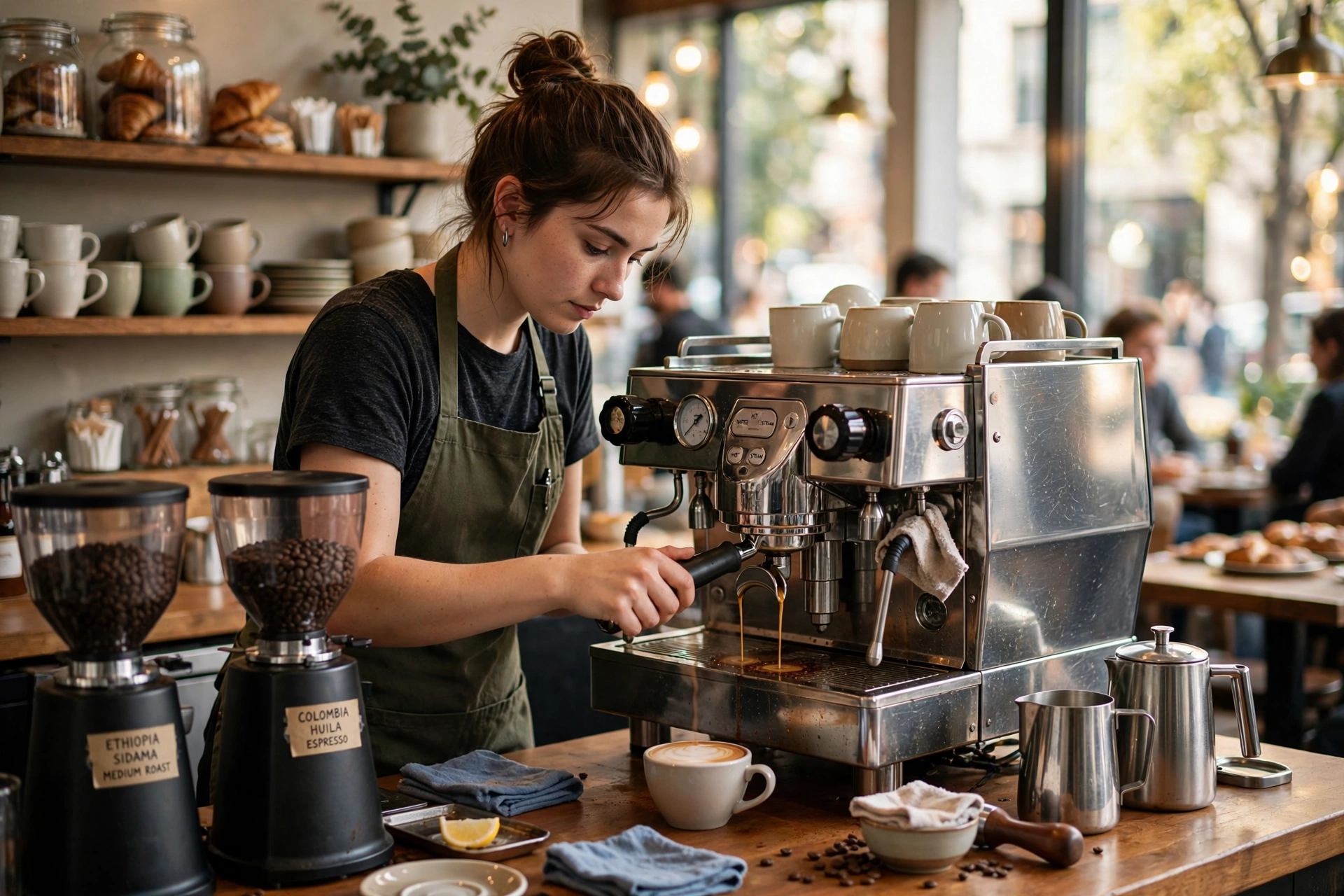
A standard professional supply chain consists of three primary tiers: the brewing core, the preservation layer, and the support infrastructure. The brewing core includes the espresso machine, bulk grinders, and precision scales. The preservation layer involves refrigerated milk dispensers, under-counter fridges, and pastry displays. Finally, the support infrastructure includes the water filtration system, knock-boxes, and tempering tools.
According to the Specialty Coffee Association (SCA), the precision of the grind and the stability of the water temperature are the two most critical variables in achieving a specialty score of 80 or above. If your equipment supply lacks a PID-controlled boiler or a high-precision burr grinder, you are essentially gambling with your product quality. I've tested this with dozens of our clients; those who skimp on the grinder but buy a top-tier espresso machine still produce mediocre coffee because the "input" (the grind) is inconsistent.
Why Does the Quality of Your Equipment Supply Directly Impact Your Bottom Line?
The cost of your cafe equipment supply is not just a line item on a balance sheet; it is a direct driver of your hourly throughput and waste percentage. High-end equipment is designed to reduce "dial-in" time and minimize the amount of coffee wasted during calibration. In a high-volume environment, a machine that saves just 10 seconds per drink can increase your total daily capacity by 20 to 30 customers.
From a financial perspective, the risk of equipment failure is the most significant threat to a new cafe. According to data from the National Coffee Association USA (NCA), operational downtime in the first year of a food service business often stems from the use of "prosumer" gear in a commercial environment. When a residential-grade machine breaks down during a morning rush, you lose not only the immediate sales but also the long-term customer trust.
Moreover, the impact on labor costs is profound. A poorly configured cafe equipment supply requires a barista to perform more manual corrections, such as hand-tamping inconsistently or manually timing shots. By investing in automated tamping or volumetric dosing, you reduce the skill floor required for your staff. This means you can hire based on hospitality and attitude, while the equipment handles the technical precision, effectively lowering your training costs and reducing employee burnout.
Practical Application: Building Your Equipment Suite Step-by-Step
Designing a workflow is more important than buying a brand name. The mistake I made early on, and that I see constantly, is buying the most expensive machine available without mapping the "Barista Path." If your grinder is three feet away from your espresso machine, your barista spends 20% of their shift walking, not brewing.
Step 1: Define Your Volume Capacity
Determine how many cups per hour you expect during your peak window. A two-group machine is sufficient for most boutique shops, but a three-group machine is essential if you are targeting 60+ drinks per hour.
Step 2: Prioritize the Water Chain
You cannot put city water directly into a $15,000 machine. You need a multi-stage filtration system. According to NSF International, scale buildup is the leading cause of boiler failure in commercial beverage equipment. Investing in a reverse osmosis (RO) system or a high-grade ion-exchange filter is a non-negotiable requirement.
Step 3: The Grinder Strategy
You need at least two grinders: one for your primary espresso roast and one for decaf or a rotating single-origin. Look for "grind-on-demand" technology to ensure the coffee bean is ground seconds before brewing, preserving the volatile aromatics of the Coffea arabica.
Step 4: Integrated Solutions
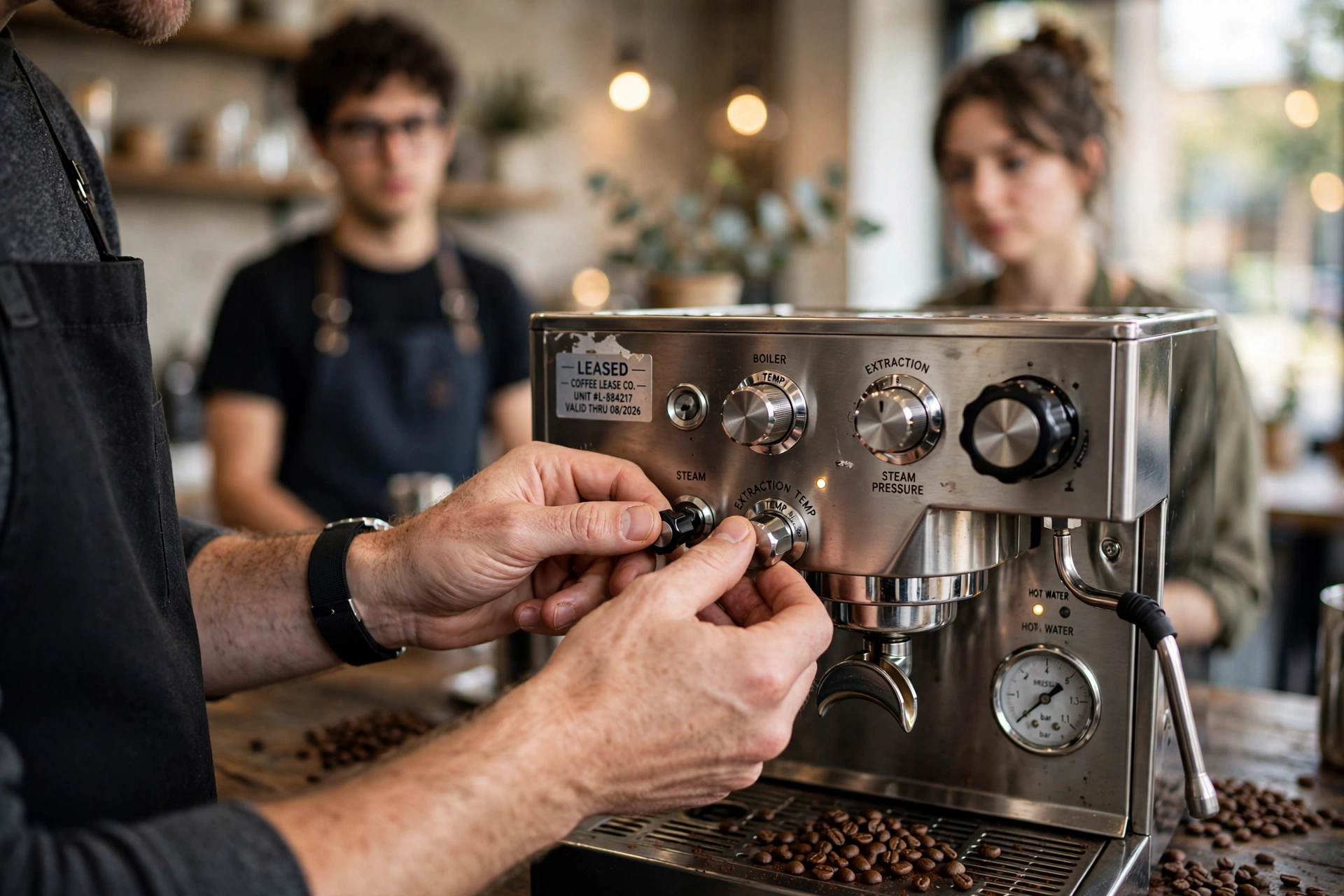
This is where many owners get overwhelmed. Managing five different vendors for five different machines is a logistical nightmare. This is why we developed the managed coffee membership at Busy Bean Coffee. Instead of a massive upfront capital expenditure, we provide the SENSA equipment, professional installation, and full maintenance for a predictable monthly fee. It transforms a volatile CAPEX (Capital Expenditure) into a stable OPEX (Operating Expenditure).
💡
Key Takeaway
Focus your budget on the "Water-Grinder-Machine" trinity. If any one of these three is weak, the entire coffee service fails regardless of the quality of the beans.

Comparing Equipment Sourcing Options
Depending on your budget and risk tolerance, you have three main paths to secure your cafe equipment supply. Most new owners assume that buying used is the best way to save money, but in the specialty coffee world, a "used" machine often means a machine with a scaled-up boiler that is one week away from exploding.
| Option | Upfront Cost | Reliability | Maintenance | Best For |
|---|---|---|---|---|
| Traditional Purchase (New) | Very High ($20k - $100k) | High | Owner's Responsibility | Established brands with deep capital |
| Used/Refurbished Gear | Low to Medium | Variable/Risky | High Frequency | Low-budget startups / hobbyist cafes |
| Managed Membership (Busy Bean) | Zero to Low | Guaranteed | All-Inclusive | Scaling businesses focusing on ROI |
When analyzing these options, consider the "Total Cost of Ownership" (TCO). A used machine might save you $5,000 today, but if it requires a $1,200 technician visit every two months and causes three days of downtime per year, the TCO is actually higher than a new lease or a managed service. The modern approach, shifting toward managed services, allows business owners to keep their cash liquid for marketing and staffing, which are the actual drivers of growth in 2026.
Common Questions and Misconceptions About Equipment Costs
Most guides get the "budgeting" part wrong because they treat cafe equipment as a one-time purchase. It isn't. It is a living system that requires a monthly "tax" in the form of consumables and calibrations.
Myth 1: "A more expensive machine automatically makes better coffee."
This is false. A $20,000 machine with a poorly calibrated grinder and hard water will produce a sour, metallic shot. The quality of the coffee is a result of the system, not the single piece of hardware. You are better off with a mid-range machine and a top-tier grinder than a luxury machine and a budget grinder.
Myth 2: "I can use a prosumer machine for the first six months to save money."
This is the fastest way to lose money. Prosumer machines are not designed for the thermal load of a commercial rush. After the fifth consecutive latte, the temperature drops, and your consistency vanishes. Furthermore, using non-certified equipment often violates health department codes and insurance policies.
Myth 3: "Maintenance is just cleaning the group heads."
Actual maintenance involves gasket replacements, screen changes, and water filter swaps. If you aren't budgeting roughly 2% to 5% of the equipment's value annually for preventative maintenance, you are simply waiting for a catastrophic failure.
Frequently Asked Questions
How much should I budget for an espresso machine vs. a grinder?
In a professional cafe equipment supply, you should generally allocate about 60% to 70% of your brewing budget to the espresso machine and 30% to 40% to the grinder. While the machine is the center of the operation, the grinder is where the actual "flavor" is unlocked. A high-end espresso machine cannot compensate for a grinder that produces an inconsistent particle size distribution. For a standard specialty shop, this typically looks like a $8,000 - $15,000 machine paired with a $2,000 - $4,000 professional grinder.
Do I really need a commercial water filtration system?
Yes, it is the most important part of your equipment chain. Most municipal water contains minerals like calcium and magnesium that create "scale" inside your machine's boilers. According to the FDA, water quality is a fundamental component of food safety and equipment longevity. Without proper filtration, you risk permanent damage to your heating elements and a bitter, "chalky" taste in your coffee. A professional system typically costs between $500 and $2,000 depending on the volume and purity required.
What is the difference between a single-boiler and a multi-boiler machine?
A single-boiler machine uses one tank of water for both brewing and steaming, which means the barista must wait for the temperature to shift between tasks. Multi-boiler machines have dedicated boilers for the group head and the steam wand, allowing for simultaneous operation without temperature fluctuation. In a commercial setting, a multi-boiler or heat-exchange system is mandatory. If you try to run a high-volume cafe on a single boiler, your output will be cut in half, and your milk texture will be inconsistent.
How long does typical commercial cafe equipment last?
With a rigorous preventative maintenance schedule, a high-quality espresso machine can last 10 to 15 years. However, the "usable life" is often shorter if the water isn't managed. Grinders typically last 5 to 7 years before the burrs need professional replacement or the motor requires an overhaul. This is why the managed service model from Busy Bean Coffee is so effective; we handle the lifecycle of the equipment, ensuring that you always have hardware that is performing at peak efficiency without having to worry about the 10-year depreciation curve.
Why is "SENSA" equipment recommended for managed services?
SENSA equipment is engineered specifically for the rigors of the foodservice industry, focusing on thermal stability and ease of maintenance. When integrated into a managed membership, these machines allow for standardized training across your entire staff. Because the equipment is professionally installed and maintained by Q-Graders and technicians, the risk of "operator error" leading to equipment failure is virtually eliminated. It provides the stability of a high-end corporate coffee chain with the soul of a local specialty shop.
Final Thoughts on Your Cafe Equipment Supply
Determining how much to spend on your cafe equipment supply is a balancing act between ambition and operational reality. Whether you are launching a small kiosk in Mount Pleasant, SC, or a full-service bistro, the goal remains the same: consistency. The most successful cafes aren't the ones with the flashiest machines, but the ones whose equipment never fails during the 8:00 AM rush.
If the thought of spending $50,000 upfront on hardware feels like a barrier to your dream, remember that you don't have to own the equipment to own the quality. By shifting your focus from "ownership" to "service," you can access world-class specialty coffee gear without the crushing capital expense.
Ready to build a world-class coffee experience without the financial stress? Visit Busy Bean Coffee to explore our all-inclusive managed coffee solutions. We provide the equipment, the expertise, and the maintenance, so you can focus on what actually matters: your customers and your community.
Free Coffee Pairing Guide & Specialty Roast Cheat Sheet
Unlock the secrets of perfect brewing ratios, water temperatures, and specialty roast profiles. Download the guide.