Best Office Coffee Subscriptions for Small Business: The Decision Framework for 2026
Choosing the best office coffee subscription for your small business in 2026 involves sifting through dozens of options, from basic bean delivery services to all-inclusive managed solutions. If you're looking for a which comparison, you've come to the right place. The problem isn't finding a subscription — it's finding the right one that actually saves you time, money, and keeps your team happy without introducing new headaches. Here's how to cut through the noise.
💡
Key Takeaway
The single most important factor is not the price per cup — it's the total cost of operation, including your time and team satisfaction.
What Is an Office Coffee Subscription?
📚
Definition
An office coffee subscription is a recurring service that supplies your workplace with coffee, equipment, and often maintenance for a predictable monthly fee. The modern version goes far beyond just dropping off beans.
The market for workplace coffee subscriptions has evolved dramatically. Ten years ago, "subscription" meant a weekly delivery of commodity-grade coffee to your break room. Today, it ranges from curated single-origin bean deliveries to fully managed corporate coffee programs that include commercial-grade espresso machines, grinders, and full-service maintenance.
According to the National Coffee Association's 2024 Workplace Coffee Report, 85% of employees now consider access to quality coffee a non-negotiable workplace perk — up from 62% in 2019. That shift has created a crowded, confusing market for small business owners trying to decide which service is right for them.
In my experience working with hundreds of small businesses across the South, the "office coffee subscription" label is often misleading. A true managed coffee subscription should answer four things:
- Who owns the equipment?
- Who handles maintenance?
- How is coffee quality controlled?
- What happens when something breaks?
Most consumer-facing subscriptions leave those questions unanswered. That's where the gap between consumer services and true managed coffee services appears.
Why It Matters: The Real Cost of Bad Office Coffee
The difference between a great office coffee program and a mediocre one isn't just taste — it's dollars and cents.
Employee retention and recruitment. A 2023 Gallup study found that replacing a salaried employee costs one-half to two times their annual salary. For a $50,000 employee, that's up to $100,000 in turnover costs. One of the easiest, lowest-cost leverage points for retention is workplace perks. Quality coffee consistently ranks among the top three most-valued perks by office workers.
Productivity and culture. Research from the University of Michigan demonstrated a 14% increase in collaborative behavior in workplaces with premium coffee options. The act of grabbing a coffee together triggers informal collaboration that drives innovation and team bonding.
The hidden cost of "cheap" coffee. Consider a 15-person office using a consumer Keurig brewer at $50 each, plus K-cups at $0.60 per cup. That's roughly $180/month for mediocre coffee that requires someone to manage inventory, clean the machine, and run to the store when it runs out. Compare that to how much does craft coffee cost in a managed program, where premium coffee, equipment, and maintenance are bundled. The "cheap" option often costs more in hidden labor and low engagement.
Hiring and employer brand. When potential hires visit your office, the break room is a signal. A cheap pod machine says "we cut corners." A professional espresso setup or high-end drip system says "we invest in our people."
How to Choose the Right Office Coffee Subscription
Now here's where it gets interesting. The best office coffee subscription for your business depends on four variables.
Step 1: Size Up Your Team
- 1–10 people: A high-end consumer subscription or a small managed service works. You probably don't need a commercial machine, but you want quality.
- 10–30 people: This is the sweet spot for a managed service. Volume justifies better equipment, and the time savings from full-service maintenance become significant.
- 30+ people: You need a commercial-grade solution. Consumer equipment will break down constantly, and the downtime costs will eat any savings.
Step 2: Assess Your Coffee Culture
Does your team actually care about coffee? If they're happy with drip, don't invest in an espresso machine they won't use. But if you have a few passionate coffee drinkers, a managed subscription with a super-automatic machine can serve everyone.
Step 3: Compare Total Cost of Ownership (TCO)
Most guides compare only the cost of beans. Here's the real TCO breakdown for a 20-person office:
| Cost Factor | DIY (Consumer Pods) | Bean Delivery | Managed Service (Busy Bean Coffee) |
|---|---|---|---|
| Coffee cost/mo | ~$240 | ~$180 | $0 (included) |
| Equipment cost/mo (amortized) | ~$30 | ~$80 | $0 (included) |
| Maintenance/repairs | ~$20/mo avg | ~$50/mo avg | $0 (included) |
| Admin time (order, clean, fix) | ~2 hrs/mo | ~3 hrs/mo | 0 hrs/mo |
| Total true cost/mo | ~$290 | ~$310 | $150–$250/mo |
The managed model often wins because of purchasing power and zero admin time.
Step 4: Evaluate Service Level
A true managed service doesn't just drop off beans — it installs premium equipment like the Best Office Espresso Machines for Small Teams in 2026, provides full maintenance, and offers automatic replenishment.
💡
Key Takeaway
The best "office coffee subscription" isn't the one with the lowest price tag — it's the one that your team actually uses every day and that requires zero effort from your team.
Step 5: Read the Fine Print
Look for contracts with:
- No long-term commitment lock-in
- Predictable flat fees (not per-cup pricing with hidden surcharges)
- Full-service maintenance included
- Flexible bean selection
Office Coffee Subscription Models Compared
Here's a direct comparison of the main types of office coffee subscription models available in 2026.
| Feature | DTC Subscription (e.g., Trade Coffee) | Office Supplier (e.g., Staples) | Managed Service (Busy Bean Coffee) |
|---|---|---|---|
| Coffee Quality | High (Specialty) | Low-Medium (Commodity) | High (Specialty Roasts) |
| Equipment | None (You buy) | Basic (You lease/buy) | Premium SENSA (Included) |
| Maintenance | None (You handle) | None (You handle) | Full Coverage (Included) |
| Bean Selection | Curated options | Limited | Flexible / Curated |
| Price Structure | Per bag | Per pod/canister | All-inclusive flat fee |
| Setup Time | Minutes | Hours | Professional installation |
| Best Fit | Coffee hobbyists | Undemanding teams | Growth-focused SMEs |
For a deeper dive into how Busy Bean compares to traditional national providers, see our analysis Busy Bean Coffee vs Aramark: Which Coffee Service Wins in 2026?.
Common Questions & Misconceptions
"We're too small for a managed coffee subscription."
This is the biggest myth in the industry. Many managed services now offer plans specifically for offices of 5–15 people. The all-inclusive model scales down well because it removes the same admin overhead from a small team that a large one faces. If your team is small but growing, now is the perfect time to implement a corporate cafe solution that can scale with you.
"Pods are the most cost-effective option."
Only if you value your time at zero. The per-cup cost of K-cups is actually higher than fresh-ground specialty coffee, and the waste generated is significant. Plus, the flavor profile of fresh-ground coffee consistently outperforms pre-ground pods in blind taste tests.
"Switching coffee services is a huge hassle."
A good managed service handles the entire transition — from removing old equipment to installing new machines and training your team. The hassle of switching is usually around two hours of total interruption, then zero ongoing work.
"My team won't use an espresso machine."
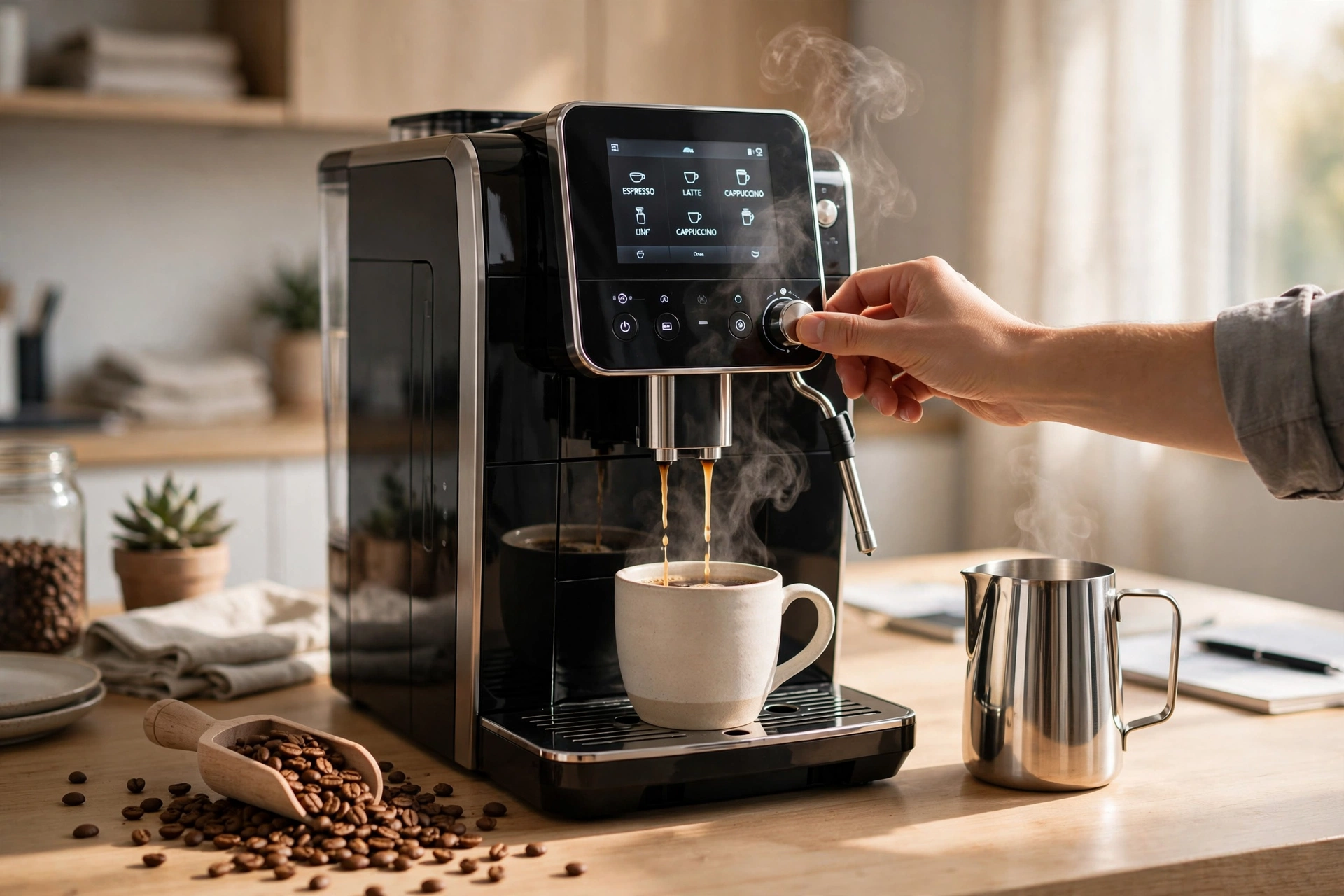
Super-automatic espresso machines have become remarkably easy to use. With a single-button operation, anyone can pull a shot, steam milk, or dispense hot water. Most teams quickly adopt them once they taste the difference.
Frequently Asked Questions
What is the average cost of an office coffee subscription?
For a small business of 10–25 people, an office coffee subscription ranges from $150 to $450 per month. Consumer-grade subscriptions are at the lower end ($150–$250) but don't include equipment or maintenance. Managed services with premium equipment and full support typically run $250–$450 per month but include everything — beans, machine, installation, and repairs. You can explore specialty bean supply pricing to compare options.
What equipment is included in a managed office coffee subscription?
Most managed subscriptions include a commercial-grade super-automatic espresso machine (or high-end drip brewer), a dedicated grinder for fresh beans, and sometimes a water filtration system. With Busy Bean Coffee, for example, you receive premium SENSA equipment, professional installation, and full coverage for any maintenance or repairs. This often saves small businesses thousands of dollars in upfront capital costs.
Can I choose the coffee beans for my office subscription?
Yes, most high-quality managed services allow you to select from a rotating menu of specialty roasts. At Busy Bean Coffee, clients can choose from multiple single-origin and blend options. The key is whether the subscription includes freshness guarantees and a consistent supply chain. If you're wondering about the full supply chain, read up on how to buy specialty coffee beans for your business.
Is an office coffee subscription better than a traditional coffee delivery service?
For most small businesses, yes. A traditional delivery service simply drops off bags of coffee and leaves you to figure out equipment, maintenance, and inventory. A true subscription bundles equipment, service, and support into a single predictable monthly fee. This eliminates the headache of maintaining a commercial machine or scrambling for replacement parts. See how it all ties together in how corporate cafe solutions work.
How do I convince my boss an office coffee subscription is worth it?
Focus on the total cost of ownership (TCO) and the impact on culture. Show the math: $5 per employee per day for premium coffee vs. $100,000+ to replace a single disengaged employee. Reference the National Coffee Association data showing 85% of employees see it as a non-negotiable perk. Frame it not as a coffee expense, but as a retention and culture investment with a measurable ROI.
Summary + Next Steps
The best office coffee subscription for your small business depends on your team size, culture, and budget. But if you value convenience, quality, and predictable costs — and you don't want to be your office's de facto coffee manager — a managed solution is the clear winner.
Ready to simplify your office coffee program? Explore how Busy Bean Coffee's all-inclusive managed membership can transform your break room into a destination. Visit Busy Bean Coffee to get started.
About the Author
Travis Estes is the founder of Busy Bean Coffee. Since 2014, he has helped hundreds of businesses — from small offices to large hospitality groups — design and operate premium coffee programs. He writes regularly about coffee culture, workplace engagement, and the business of great coffee.
Free Coffee Pairing Guide & Specialty Roast Cheat Sheet
Unlock the secrets of perfect brewing ratios, water temperatures, and specialty roast profiles. Download the guide.