Why Invest in Industrial Coffee Roasters for Your Business?
Scaling a coffee operation without the right hardware is a recipe for inconsistent quality and wasted margins. Many businesses start with small-batch roasting or outsource their roasting entirely, only to find that as volume increases, the lack of control over the roast profile leads to a fragmented brand identity. The primary reason to transition to industrial coffee roasters is the ability to achieve absolute thermal stability and batch-to-batch repeatability at a scale that makes high-end specialty coffee economically viable. When you control the roast, you control the cost of goods sold (COGS) and the sensory experience of every cup served.
In my experience working with hospitality groups and high-volume cafes, the biggest mistake I see is the "incremental upgrade" trap. Owners buy a slightly larger sample roaster, then another, failing to realize that industrial-grade machinery isn't just about volume; it is about precision engineering. A commercial drum or fluid-bed roaster allows for precise air-flow manipulation and heat application that simply cannot be replicated by consumer-grade equipment. This is essential for those implementing a Sensa Coffee Service in Charlotte, NC, where the demand for consistency across multiple locations is non-negotiable.
Understanding the Mechanics of High-Capacity Roasting
To understand why industrial equipment is necessary, we must first define what separates it from artisan or home equipment. While a home roaster might rely on simple timers and visual cues, an industrial system is a data-driven engine designed for continuous operation.
📚
Definition
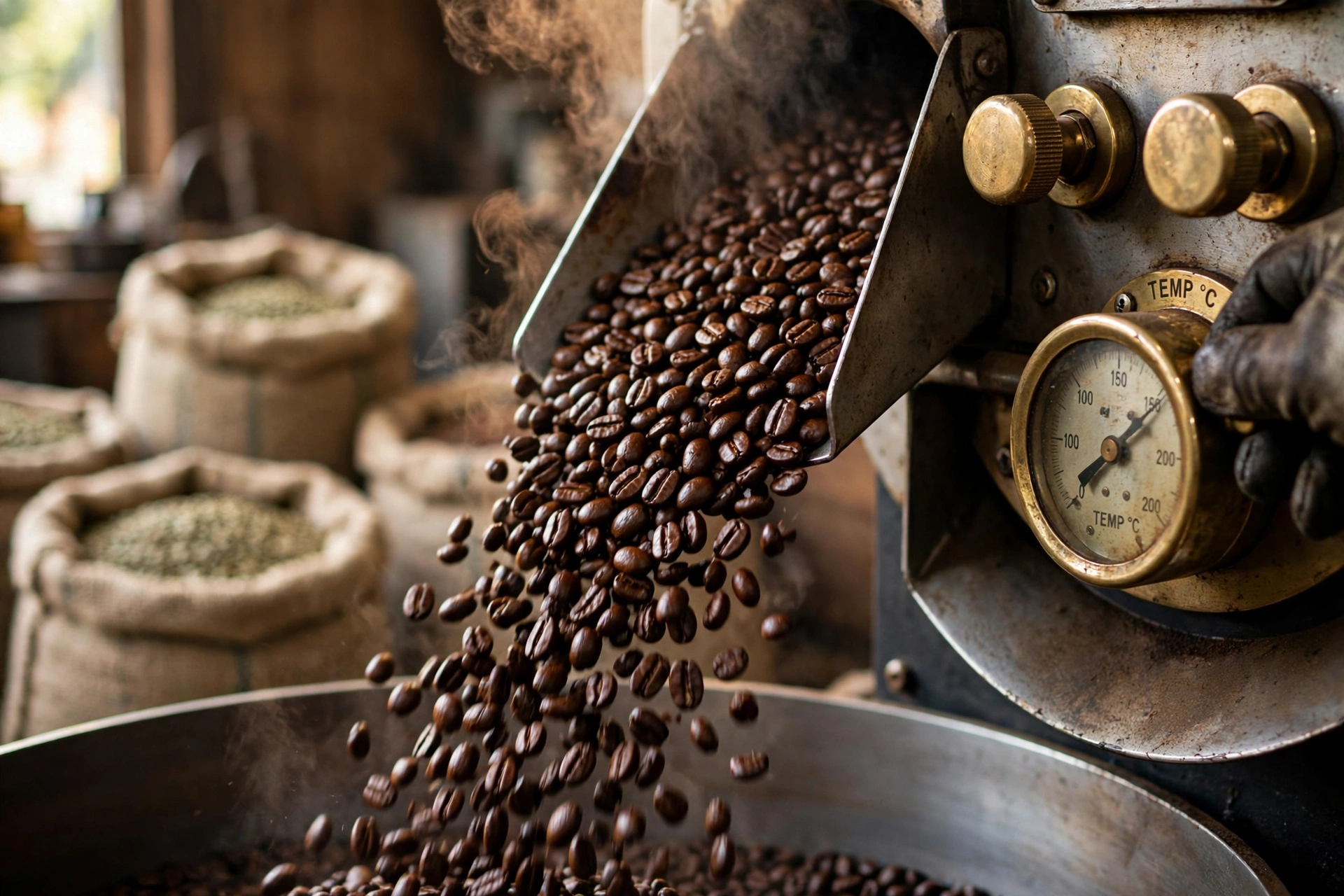
Industrial coffee roasting is the process of using large-scale, thermally stabilized machinery to convert raw green coffee beans into roasted beans through controlled conductive, convective, and radiative heat transfer, typically handled in batches ranging from 15kg to 120kg or more.
The core of any industrial system is the ability to manage "the roast curve." This is the graphical representation of bean temperature over time. In a professional setting, this isn't left to chance. Using software like Cropster or Artisan, roasters can track the Rate of Rise (RoR), ensuring that the beans hit the "first crack" at the exact second required to preserve the volatile aromatic compounds of the Coffea arabica species.
According to the Specialty Coffee Association (SCA), the precision of temperature control during the Maillard reaction (where sugars and amino acids react) is what determines the final quality score of a specialty coffee. Industrial roasters provide the heavy-duty steel and advanced burners necessary to maintain these temperatures regardless of whether the ambient room temperature is 60°F or 90°F. This thermal mass is what allows a business to roast 500 pounds of coffee a week without the 50th batch tasting different from the first.

Why Industrial Roasting Matters for the Bottom Line
The decision to move toward professional roasting equipment is rarely just about the "art" of the coffee; it is a calculated financial move. When a business relies on third-party roasting, they are paying for the roaster's overhead, labor, and profit margin on every pound of coffee. By bringing this in-house with industrial equipment, the business shifts from paying a retail price per pound to a wholesale green coffee price.
Data from the International Coffee Organization (ICO) indicates that green coffee prices fluctuate based on global commodity markets. Businesses with their own roasting capacity can hedge these risks by purchasing green beans in larger quantities during price dips and storing them, which is impossible if you are buying pre-roasted bags. This vertical integration can reduce coffee costs by 30% to 50% over time.
Furthermore, the consequences of not acting on this upgrade are severe for growing brands. If you are operating a Foodservice Coffee Program in Chicago IL: Complete Guide, relying on a small-scale roaster means you will eventually hit a "ceiling" where you cannot fulfill orders without sacrificing quality. This leads to "roast drift," where the coffee tastes different every week, eroding customer loyalty.
The impact on labor is also significant. Industrial roasters often feature automated loading and unloading systems. Instead of a skilled barista spending four hours a day manually tending to a small roaster, a dedicated roastmaster can process hundreds of kilograms in a fraction of the time. This allows the staff to focus on high-value activities, such as optimizing Automatic Coffee Machines for Hotels and Hospitality in 2026 to ensure the end-user experience matches the quality of the bean.
Practical Application: Implementing an Industrial Roasting Program
Transitioning to industrial roasting is not as simple as plugging in a machine. It requires a strategic approach to facility design, gas lines, and ventilation. If you simply place a high-capacity roaster in a standard kitchen, you will face immediate issues with smoke and heat exhaustion.
Step 1: Facility Assessment and Ventilation
Industrial roasters produce significant amounts of chaff (the skin of the coffee bean) and smoke. You must install a dedicated afterburner or a high-efficiency filtration system. In my experience, failing to invest in a proper afterburner is the fastest way to get a "cease and desist" from local fire marshals or complaints from neighboring businesses.
Step 2: Gas and Power Infrastructure
Most industrial roasters run on natural gas or propane. You will need a high-BTU line installed by a licensed professional. Additionally, the cooling tray motors and control panels require stable power to prevent "brown-outs" that can ruin a batch of expensive specialty beans.
Step 3: Sourcing Green Coffee and Profile Development
Once the hardware is in place, the focus shifts to the coffee bean. You must establish relationships with importers to source high-quality Arabica. Use your industrial equipment to create a "signature roast" that defines your brand.
Step 4: Integration with Service
The roast is only half the battle. The coffee must be delivered via an optimized system. For those who prefer a managed approach, Busy Bean Coffee provides the end-to-end infrastructure to ensure that these high-quality roasts are served perfectly. Whether you need a Sensa Coffee Service in Raleigh NC (2026 Overview) or a wider distribution, the equipment must match the bean quality.
💡
Key Takeaway
The ROI of industrial roasting comes from the combination of reduced COGS, absolute quality control, and the ability to scale volume without linear increases in labor costs.

Choosing the Right Path: Roasting Options Comparison
Not every business needs a 120kg drum roaster. The "best" option depends on your daily throughput and your commitment to a specific roast profile. Here is how the different approaches compare:
| Approach | Pros | Cons | Best For |
|---|---|---|---|
| Small-Batch/Artisan | Low initial cost, high flexibility for micro-lots. | High labor cost per lb, inconsistent at scale. | Boutique cafes, experimental roasters. |
| Outsourced Roasting | Zero equipment risk, no maintenance. | Highest cost per lb, no control over roast timing. | New businesses, low-volume sites. |
| Industrial Roasting | Lowest cost per lb, absolute consistency, brand control. | High upfront CAPEX, requires specialized facility. | Regional chains, hotels, large foodservice. |
The "Generic AI Approach" to roasting, relying on automated presets without human Q-Grader oversight, often results in "flat" coffee that lacks the nuanced acidity and sweetness of a true specialty roast. The professional approach combines the power of industrial machinery with the palate of a certified expert. This is the philosophy we employ at Busy Bean Coffee, ensuring that the technology serves the taste, not the other way around.
Common Questions and Misconceptions
Many business owners hesitate to invest in industrial coffee roasters because of a few common myths. Most guides get this wrong by suggesting that "small is better" for quality.
Myth 1: "Small roasters produce better quality coffee."
This is a fallacy. Quality is a result of thermal stability. Small roasters often suffer from "temperature swings" because they lack the thermal mass of a large cast-iron drum. An industrial roaster, when properly managed, provides a much more stable environment, leading to a more uniform roast throughout the bean.
Myth 2: "Industrial roasting is too complex for a standard manager to handle."
While it requires training, modern industrial roasters are designed for repeatability. Once a roast profile is locked in via software, the machine essentially follows a digital map. The complexity is in the initial setup, not the daily operation.
Myth 3: "The upfront cost is too high to justify."
If you look at the spreadsheets, the "cost of inaction" is often higher. If you are paying a 40% markup to a third-party roaster and processing 1,000 pounds a month, you are losing thousands of dollars in potential profit every year. The equipment pays for itself through margin recovery.
Frequently Asked Questions
How does an industrial coffee roaster improve consistency compared to smaller machines?
Industrial roasters utilize significantly more thermal mass, meaning the metal drum and the heating elements hold a consistent temperature even when a large volume of cold green beans is introduced. In smaller machines, the "temperature crash" is more severe, making it harder to maintain a steady Rate of Rise (RoR). By using high-precision burners and automated airflow, industrial systems ensure that every bean in a 50kg batch experiences the exact same heat application. This eliminates the "mottled" roast look and ensures the flavor profile remains identical across different days and batches.
What are the primary safety requirements for installing a commercial roaster?
Safety is the most overlooked aspect of roasting. According to NSF International, commercial food equipment must meet strict sanitary and safety standards to prevent contamination and hazards. For roasting, the most critical requirement is the installation of a certified afterburner to eliminate carbon monoxide and smoke. Additionally, you must have a professional gas leak detection system and a dedicated fire suppression plan. Because roasting involves high heat and combustible chaff, the area must be kept clear of flammable materials, and the ventilation system must be cleaned regularly to prevent "chaff fires" within the ducting.
How long does it typically take to see a return on investment (ROI) for an industrial roaster?
The ROI timeline varies based on volume, but for a mid-sized foodservice operation, the break-even point typically occurs between 18 and 36 months. The primary driver is the shift from buying roasted coffee at retail or wholesale prices to buying green coffee. When you eliminate the middleman, your cost per pound drops precipitously. For example, a business managing a Sensa Coffee Service in Jacksonville, FL that processes high volumes daily will see the savings manifest in their monthly P&L almost immediately after the initial installation and training phase.
Can industrial roasters handle different types of beans without affecting quality?
Yes, but it requires "profile adjustments." Because different origins, such as a high-altitude Ethiopian bean versus a Brazilian bean, have different densities and moisture levels, they react differently to heat. Industrial roasters allow you to save these specific profiles digitally. This means you can switch from roasting a light-roast Arabica to a dark-roast blend by simply loading a different software profile. This flexibility allows a business to offer a diverse menu of specialty coffees without risking the batch quality, which is a key advantage for those using Sensa Coffee Service in Savannah GA: Complete Guide | Busy Bean Coffee.
What is the difference between a drum roaster and a fluid-bed roaster in an industrial setting?
A drum roaster uses a rotating cylinder to move beans through heat via conduction (contact with the metal) and convection (hot air). It is the traditional choice for those seeking a classic, full-bodied flavor profile. A fluid-bed roaster, on the other hand, suspends the beans in a stream of hot air, relying almost entirely on convection. Fluid-bed roasting is often faster and can produce a "cleaner" taste, which is highly prized in some specialty coffee circles. The choice depends on your target flavor profile and the specific requirements of your Business Coffee Membership in Boston MA: Complete Guide.
Final Thoughts on Industrial Coffee Roasters
Investing in industrial coffee roasters is the definitive move for any coffee business that intends to scale without compromising its soul. The ability to control the roast curve, eliminate the "middleman" markup, and ensure that a customer in one location has the exact same sensory experience as a customer in another is what separates a local cafe from a regional powerhouse.
The transition requires a commitment to infrastructure and a willingness to embrace a data-driven approach to roasting. However, the rewards, higher margins, brand autonomy, and superior quality, far outweigh the initial hurdles. Whether you are expanding your current footprint or launching a new high-volume venture, the precision of industrial hardware is your most valuable asset.
If you are looking to elevate your beverage program without the headache of managing every single gear and gasket yourself, Busy Bean Coffee provides the perfect balance of premium equipment and managed expertise. From professional installation to a predictable monthly fee, we handle the complexity so you can focus on the coffee.
Explore our managed solutions today at www.busybeancoffee.com and see how we can transform your coffee service into a profit center. For those looking for a regional jumpstart, consider our Sensa Coffee Service in Mount Pleasant SC: Complete Guide.
Ready to Upgrade Your Business Coffee?
Café-quality coffee, zero maintenance headaches, and one predictable monthly price. Let's build your custom coffee program.
Free Coffee Pairing Guide & Specialty Roast Cheat Sheet
Unlock the secrets of perfect brewing ratios, water temperatures, and specialty roast profiles. Download the guide.