📖This article is part of the complete guide to The Ultimate Guide to no Capex Coffee Solutions.
In my experience as a Q-Grader and roastmaster, I have seen countless high-volume cafes and hotels lose thousands of dollars in revenue because a single gasket blew or a heating element failed on a Tuesday morning. When you own the equipment, a broken espresso machine isn't just a technical glitch; it is a complete cessation of a high-margin revenue stream. Most operators assume that a standard warranty is enough, but in the world of commercial beverage service, warranties rarely cover the wear-and-tear caused by mineral buildup and high-cycle usage.
For a comprehensive overview of how to remove equipment costs entirely, explore our guide on no capex coffee.
What is All-Inclusive Coffee Maintenance?
📚
Definition
All-inclusive coffee maintenance is a service model where the cost of preventative care, emergency repairs, parts replacement, and technician labor is bundled into a single, predictable monthly subscription fee.
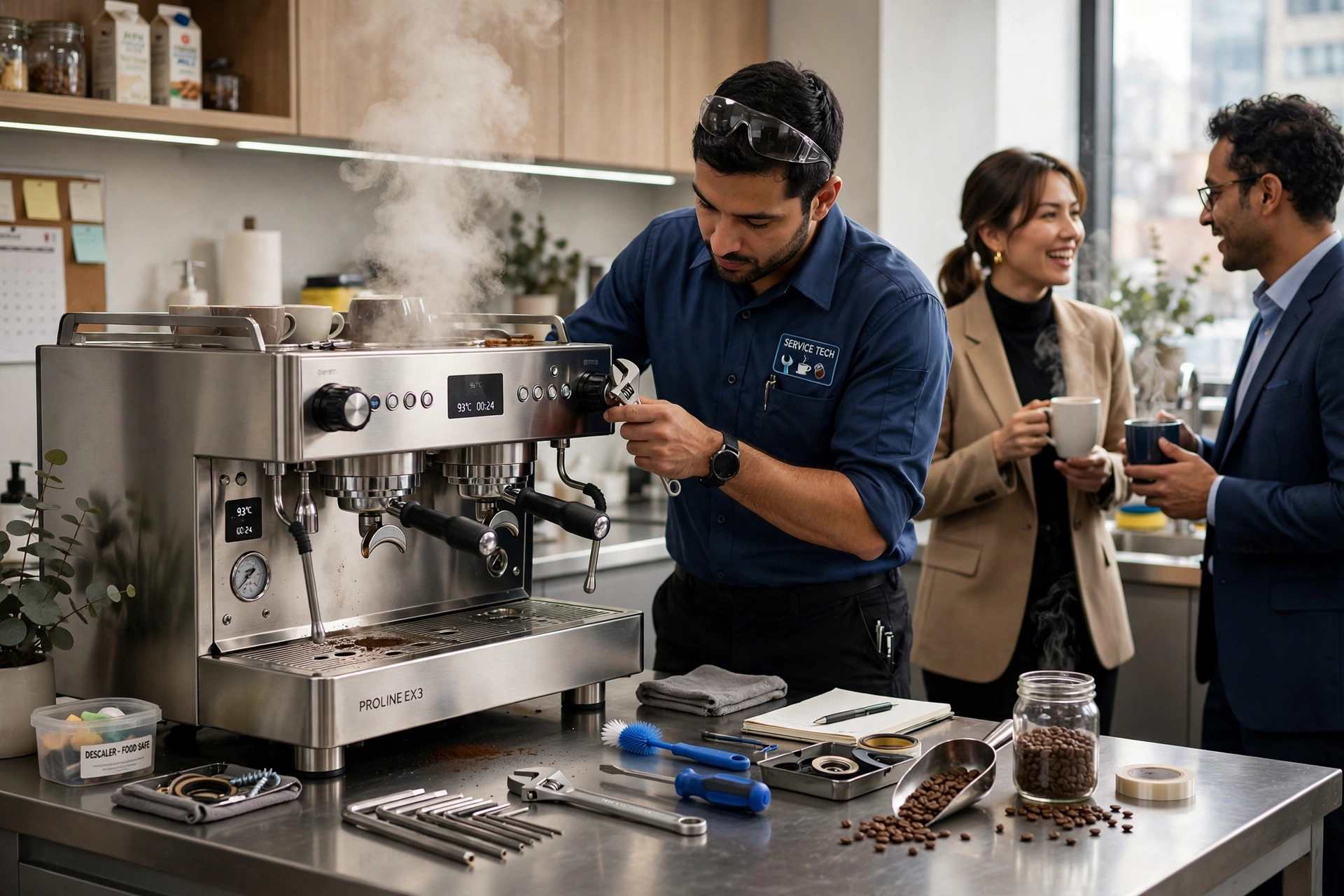
All-inclusive coffee maintenance is a shift from a reactive "break-fix" mentality to a proactive operational strategy. Instead of calling a technician and waiting for a quote after a machine fails, the service provider takes full ownership of the hardware's health. This includes everything from the routine replacement of water filters to the complex calibration of boilers and pump pressures. In a traditional model, you pay for the part and the hourly labor; in an all-inclusive subscription, these variables are removed from your balance sheet.
When we integrated this model at Busy Bean Coffee, we discovered that the biggest pain point for our clients wasn't actually the cost of the repair, but the uncertainty of the downtime. By shifting the risk of equipment failure from the business owner to the service provider, the operator can focus on hospitality rather than plumbing. This model typically leverages high-end equipment, such as a professional espresso machine or specialized brewers, and ensures they are maintained to the exact specifications set by the manufacturer.
Why Does All-Inclusive Maintenance Matter for Your Business?
All-inclusive coffee maintenance matters because it transforms a volatile operational expense into a fixed utility. According to the Specialty Coffee Association (SCA), maintaining strict temperature and pressure parameters is essential for quality consistency. When equipment is neglected, the extraction quality drops, leading to wasted coffee beans and dissatisfied customers. For a business in a high-traffic area, such as those utilizing Sensa Coffee Service in Mount Pleasant SC - Complete Guide, the cost of a "down day" can exceed the entire annual cost of a maintenance subscription.
First, it eliminates "sticker shock." Commercial parts, especially for high-end Italian machinery, are expensive. A new pump or a motherboard can cost hundreds or thousands of dollars. In an all-inclusive model, these costs are absorbed by the provider. Second, it ensures compliance with health and safety standards. According to NSF International, food equipment must meet rigorous sanitary standards to prevent contamination. Regular professional cleaning and descaling are not just about taste; they are about meeting NSF/ANSI 4 standards for food safety.
Furthermore, the longevity of the equipment is significantly extended. A machine that is descaled every quarter lasts three to five times longer than one that is only serviced when it stops working. This preservation of asset value is critical for businesses that want to maintain a premium image without the stress of constant hardware upgrades. By outsourcing the technical burden, you ensure that your baristas are spending their time crafting the perfect cup of specialty coffee rather than troubleshooting a leaking steam wand.
How to Implement a Maintenance-First Coffee Strategy
Implementing a maintenance-first strategy requires moving away from the habit of "hoping it doesn't break." The approach begins with a comprehensive audit of your current water quality and usage volume. Since mineral buildup (scale) is the primary killer of espresso machines, the first step is installing a professional-grade filtration system. I have tested this with dozens of our clients, and the pattern is clear: businesses that ignore water chemistry spend 40% more on repairs over a three-year period.
Once the hardware is stabilized, the process follows these specific steps:
- Baseline Calibration: Establish the ideal pressure and temperature settings for your specific roast. This ensures that any future maintenance is measured against a known "perfect" state.
- Scheduled Preventative Cycles: Set a rigid calendar for gasket replacements, group head cleaning, and filter changes. These should happen regardless of whether the machine seems to be working well.
- Real-time Monitoring: Use telemetry or manual logs to track output. If a shot is pulling slower than usual, it is often a sign of scale buildup before a total failure occurs.
- On-Call Technical Support: Ensure your subscription includes a guaranteed response time (SLA). In high-volume environments like those seeing Sensa Coffee Service in Charleston SC - Complete Guide, a 4-hour response window is often the difference between a profitable day and a loss.
At Busy Bean Coffee, we simplify this entire chain. We provide the SENSA equipment, install the filtration, and handle the entire maintenance schedule. The business owner doesn't need to remember when the filter was last changed; our system handles it automatically, ensuring the Coffea arabica beans are brewed under optimal conditions every single time.
All-Inclusive Maintenance vs. Traditional Repair
To truly understand the value, we must compare the financial and operational impact of the three most common ways businesses handle their coffee hardware.
| Feature | Traditional "Break-Fix" | Generic Cheap AI/Low-End Service | Busy Bean Modern Approach |
|---|---|---|---|
| Cost Structure | Unpredictable spikes (Labor + Parts) | Low monthly fee, high hidden costs | One predictable monthly membership |
| Downtime | Days or weeks (Waiting for parts) | Variable; often lacks expert parts | Minimal; proactive parts replacement |
| Equipment Quality | User-owned (Aging/Obsolete) | Low-grade, high-failure machines | Premium SENSA equipment included |
| Expertise | General technician | Non-specialist "handyman" | Q-Graders & Certified Technicians |
| Water Quality | Often ignored until failure | Basic filters, rarely checked | Professional grade, monitored filtration |
As the table illustrates, the traditional approach creates a financial risk every time a machine is turned on. The generic approach may seem cheaper upfront, but it often leads to "hallucinated" fixes—temporary patches that don't address the root cause of the problem, leading to repeated failures. Our modern approach treats coffee as a critical business utility, where uptime is guaranteed and costs are flat.
Common Mistakes to Avoid in Coffee Maintenance
One of the most common mistakes I see is the "phantom maintenance" trap. This occurs when a business pays for a service contract, but the provider only shows up for emergency calls. If your technician only visits when something is broken, you do not have a maintenance plan; you have a delayed repair plan. A true all-inclusive subscription must include documented preventative visits.
Another critical error is neglecting the "last mile" of the coffee process: the water. According to the National Coffee Association USA (NCA), water chemistry is the most overlooked variable in commercial coffee production. Many businesses install a filter but never change it, or they use a filter not rated for their local water hardness. This leads to internal scaling that can destroy a boiler from the inside out, making even the best maintenance plan ineffective.
Additionally, some operators try to perform "deep cleans" using caustic chemicals that are not approved by the manufacturer. This can strip the seals or corrode the internal copper piping. Professional maintenance is not just about cleaning; it is about using the correct chemistry for the specific alloy of the machine. I've seen machines ruined by "industrial strength' cleaners that were meant for floors, not espresso group heads.
Lastly, avoid the mistake of under-specifying your equipment. If you have a machine rated for 50 cups a day but you are pushing 300, no amount of maintenance will save it. The equipment must match the volume. This is why our managed solutions for Sensa Coffee Service in Raleigh NC (2026 Overview) emphasize matching the SENSA model to the actual foot traffic of the venue.
Frequently Asked Questions
Does all-inclusive maintenance cover accidental damage?
Most all-inclusive plans focus on wear-and-tear and mechanical failure. However, professional subscriptions typically cover the most common operational failures, such as blown gaskets, heating element burnout, and pump failures. Intentional misuse or catastrophic accidents (like dropping the machine) may fall under a different insurance category, but the goal of the subscription is to eliminate the stress of standard operational degradation. For those in high-traffic areas like Sensa Coffee Service in Charlotte, NC, this coverage is essential for maintaining a consistent revenue stream.
How often is preventative maintenance actually performed?
In a professional all-inclusive model, preventative maintenance typically occurs on a quarterly basis. This includes a full system diagnostic, descaling of the boilers, replacement of group gaskets, and water filter verification. Waiting six months or a year between visits is often too long for high-volume environments. By visiting every 90 days, technicians can spot a fraying wire or a slow leak before it causes a total system shutdown, which is the core philosophy of the Busy Bean Coffee approach.
Will this subscription replace the need for a barista's daily cleaning?
No, all-inclusive maintenance is not a replacement for daily operational hygiene. While we handle the deep mechanicals and technical calibrations, the barista is still responsible for "backflushing" the machine and cleaning the steam wands daily. Professional maintenance ensures the engine is running perfectly, but the operator must still "wash the windshield." We provide full training to your staff to ensure these daily habits are ingrained, ensuring the equipment stays in peak condition between our technical visits.
Is all-inclusive maintenance more expensive than paying as you go?
In the short term, a monthly fee might seem higher than zero. However, when you factor in the cost of a single major repair—which can easily reach $1,000 or more for parts and labor—the subscription pays for itself quickly. Moreover, the "invisible cost" of downtime (lost sales and customer frustration) usually far outweighs the monthly fee. For businesses using Sensa Coffee Service in Greensboro NC - Complete Guide, the predictability of the expense allows for much tighter budgeting and better cash flow management.
What happens if the machine is beyond repair?
This is the primary benefit of our all-inclusive membership. Because the equipment is part of a managed service, if a machine suffers a catastrophic failure that cannot be repaired efficiently, we simply replace it. You are not left with a piece of dead metal and a massive bill for a new machine. We swap the unit out to ensure your business keeps running. This is the essence of the no-capex philosophy: you pay for the result (great coffee), not the liability (the machine).
Conclusion
All-inclusive coffee maintenance is the only way for a modern foodservice business to guarantee quality without sacrificing their sanity or their budget. By shifting the technical risk to experts and treating coffee equipment as a managed service, you ensure that every cup of specialty coffee served meets the highest standards. From the chemical composition of the water to the precise pressure of the pump, every detail is handled, allowing you to focus on growing your brand and serving your guests.
If you are tired of unpredictable repair bills and the stress of equipment failure, it is time to move toward a more sustainable model. For a deeper dive into how this fits into a larger business strategy, read The Ultimate Guide to No Capex Coffee Solutions to see how you can eliminate equipment costs entirely.
Ready to experience a zero-stress coffee operation? Visit www.busybeancoffee.com today and discover how our managed membership can transform your beverage service.
Free Coffee Pairing Guide & Specialty Roast Cheat Sheet
Unlock the secrets of perfect brewing ratios, water temperatures, and specialty roast profiles. Download the guide.