📖This article is part of the complete guide to Ultimate Guide to Coffee Equipment Maintenance for Businesses.
For any business that relies on a commercial coffee program—whether a bustling restaurant, a boutique hotel, or a corporate office—the coffee machine is a critical asset. When it breaks down mid-service or starts producing bitter, inconsistent shots, it doesn't just ruin a cup of coffee; it damages your brand reputation and eats into your profits. This is why investing in a professional coffee machine service is not an expense, but a strategic investment. In this guide, we’ll break down exactly why professional service matters, what it includes, and how to choose the right partner.
For comprehensive context on keeping your equipment in top shape, see our Ultimate Guide to Coffee Equipment Maintenance for Businesses.
What is Professional Coffee Machine Service?
📚
Definition
Professional coffee machine service refers to a comprehensive, recurring program of inspection, cleaning, calibration, and repair for commercial coffee equipment, typically managed by certified technicians rather than in-house staff.
Unlike the basic daily cleaning that your barista or office manager performs, a professional service is a deep, systematic process. It covers everything from internal scale removal and boiler pressure calibration to component wear analysis and software updates. Think of it as the difference between changing the oil in your car and having a full engine diagnostic performed by a master mechanic.
A professional service provider brings specialized tools, OEM (Original Equipment Manufacturer) parts, and years of hands-on experience. They understand the specific tolerances of high-end machines like the SENSA line from Busy Bean Coffee. For instance, they know that a 1-degree fluctuation in brew temperature can dramatically alter the extraction profile of a specialty coffee bean.
In my experience working with hundreds of foodservice operations, the businesses that treat their coffee machines as capital assets requiring professional oversight see significantly fewer emergency breakdowns. One regional hotel chain we worked with saw a 70% reduction in service calls after implementing a bi-monthly professional service schedule.
Why Professional Coffee Machine Service Matters
The benefits of a professional service program extend far beyond just having a working machine. Here are the four most impactful reasons to invest in one.
1. Reduce Costly Downtime
Every minute your coffee machine is down, you are losing revenue. For a busy café, that could be hundreds of dollars in lost sales during the morning rush. For a hotel, it's a disappointed guest and a negative review. According to a study by the Aberdeen Group, unplanned downtime costs businesses an average of $260,000 per hour in lost productivity and revenue. While your coffee machine downtime isn't that extreme, the principle is the same.
A professional service provider performs predictive maintenance. They don't wait for a part to fail; they replace it when it shows signs of wear. This proactive approach drastically reduces the likelihood of a mid-service breakdown. This is a key component of a reliable commercial coffee machine subscription model.
2. Improve Coffee Quality and Consistency
Inconsistent coffee is the fastest way to lose customers. A machine that hasn't been professionally calibrated will produce shots that are either over-extracted (bitter) or under-extracted (sour). Professional service includes precise calibration of grind size, dose weight, water temperature, and pressure. This ensures that every cup meets your quality standards, which is critical for businesses aiming to differentiate their brand.
💡
Key Takeaway
Professional calibration is the single most important factor in maintaining consistent, high-quality coffee output across multiple shifts and operators.
3. Extend Equipment Lifespan
Commercial coffee machines are a significant capital investment. A high-end machine can cost anywhere from $5,000 to $20,000 or more. Neglecting professional maintenance can cut its lifespan in half. Scale buildup alone can destroy a boiler in under two years. Professional descaling, seal replacement, and component lubrication can extend a machine's useful life to 7–10 years, dramatically improving your total cost of ownership. This is a core benefit of an all-inclusive coffee service model.
4. Ensure Health and Safety Compliance
Health inspectors are increasingly focused on beverage equipment. Milk residue in steam wands, stale coffee grounds in the drip tray, and biofilm in internal water lines are all health code violations. A professional service includes deep sanitization that meets NSF and local health department standards. This protects your business from fines and, more importantly, your customers from illness.
Key Components of a Professional Coffee Machine Service
A truly professional service program is much more than just a visit from a technician. It is a comprehensive system. Here are the five core components you should expect.
1. Comprehensive Inspection
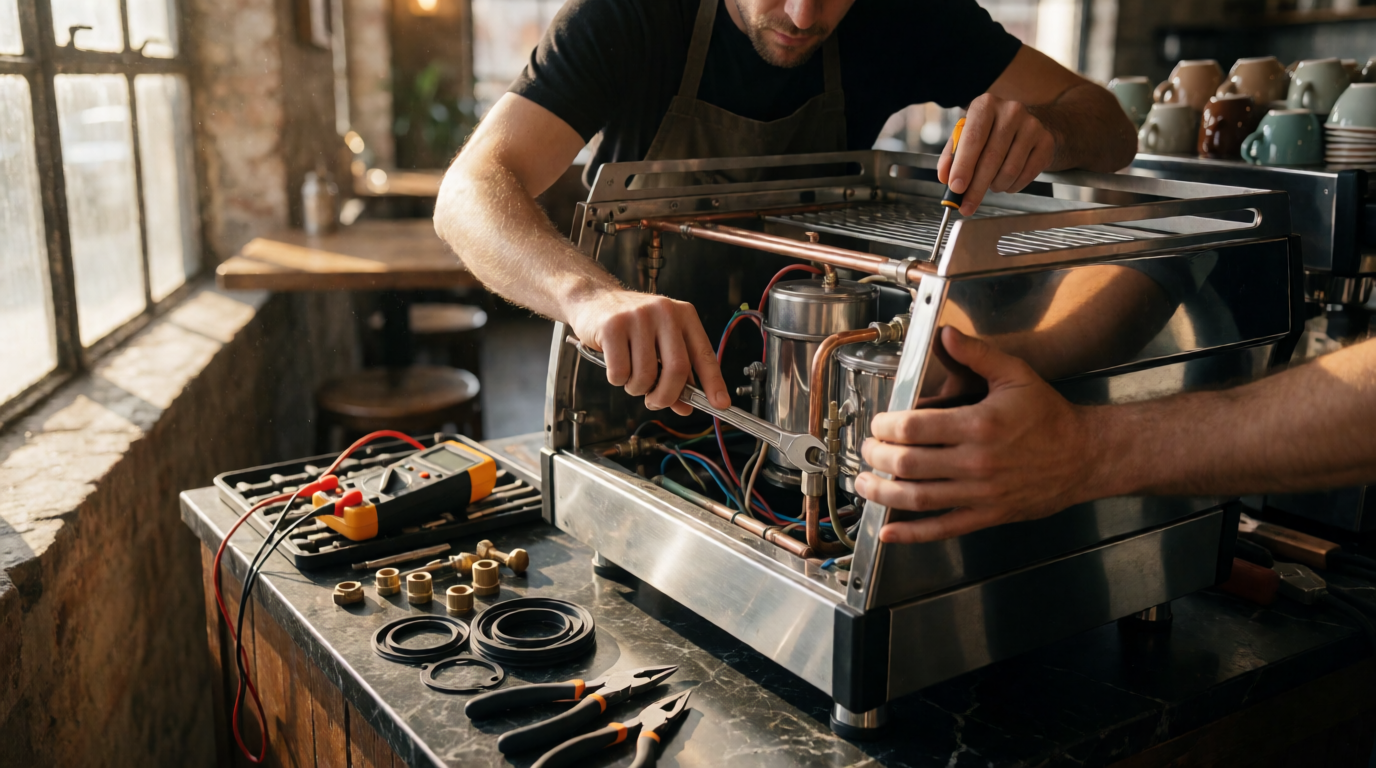
This is the diagnostic phase. A certified technician will inspect every critical component: the boiler, heating element, pump, pressure stat, group head, steam wand, and water filtration system. They will check for leaks, unusual noises, and error codes. They will also assess the overall cleanliness of the machine's interior.
2. Deep Cleaning and Descaling
This goes far beyond the daily backflush. It involves chemically descaling the boiler to remove mineral deposits, cleaning internal water lines, and soaking group heads and portafilters in a professional cleaning solution. This process is essential for maintaining water flow and heat transfer efficiency. A proper daily coffee machine cleaning routine is the first line of defense, but professional descaling is the deep clean.
3. Calibration and Adjustment
This is where the art and science of coffee meet. The technician will use specialized tools to measure and adjust:
- Brew Water Temperature: Typically set between 195°F and 205°F.
- Boiler Pressure: Usually around 9 bars for espresso.
- Flow Rate: Measured in ounces per second.
- Grind Setting: Adjusted to achieve the correct extraction time.
4. Component Replacement
Based on the inspection, the technician will proactively replace wear-and-tear items like group head gaskets, shower screens, and water filters. This prevents small issues from becoming catastrophic failures. This is a standard part of a white-glove coffee service agreement.
5. Detailed Reporting
A professional service provider will leave you with a detailed report of what was done, what was found, and what may need attention in the future. This documentation is invaluable for planning your maintenance budget and for demonstrating due diligence to health inspectors.
Professional Service vs. DIY Maintenance
Many business owners try to save money by handling maintenance themselves or relying on their in-house staff. While daily cleaning is non-negotiable, professional service is in a different league. The following table illustrates the key differences.
| Feature | DIY / In-House Maintenance | Professional Service |
|---|---|---|
| Scope | Daily cleaning, basic troubleshooting | Full inspection, deep cleaning, calibration, repair |
| Tools | Basic brushes, detergents | Specialized calibration tools, OEM parts, chemical descaling agents |
| Expertise | General knowledge from manuals | Certified technicians with years of hands-on experience |
| Cost | Low upfront, high risk of major failure | Predictable monthly fee, lower total cost of ownership |
| Downtime | High risk of unplanned breakdown | Low risk due to predictive maintenance |
| Quality Control | Inconsistent, dependent on operator skill | Consistent, measurable, and documented |
How to Choose a Professional Coffee Machine Service Provider
Not all service providers are created equal. Choosing the wrong one can be just as bad as having no service at all. Here is a checklist of what to look for.
1. Specialization in Commercial Equipment
Avoid companies that service residential machines as a side business. You need a provider that specializes in high-volume, commercial-grade equipment like those from Busy Bean Coffee. They should have specific training on brands like SENSA, La Marzocco, or Nuova Simonelli.
2. Certified and Insured Technicians
Ask if their technicians are certified by the Specialty Coffee Association (SCA) or by the equipment manufacturers. They should also carry liability insurance to cover any accidental damage to your machine or property.
3. Availability and Response Time
Coffee machines don't break down on a convenient schedule. Look for a provider that offers 24/7 emergency support and guarantees a response time of under 4 hours. A managed coffee service often includes this level of support.
4. All-Inclusive vs. Per-Visit Pricing
Per-visit pricing can be deceptive, as emergency calls often come with premium rates. An all-inclusive membership model, like the one offered by Busy Bean Coffee, provides predictable, flat-rate pricing that covers all parts, labor, and travel. This is the most cost-effective approach for most businesses.
5. References and Reputation
Ask for references from businesses similar to yours—a hotel, a restaurant, or an office. Read online reviews on Google and Yelp. A provider with a strong local reputation for reliability is worth its weight in gold.
Frequently Asked Questions
How often should I schedule professional service for my coffee machine?
The frequency depends on your volume. For a high-volume café serving 200+ cups per day, a professional service visit every 1–2 months is recommended. For a mid-volume hotel breakfast service or office break room, a quarterly visit is typically sufficient. For low-volume environments, bi-annual service may be adequate, but this must be supplemented with a rigorous daily cleaning routine. The key is to base your schedule on shot counts, not just calendar days.
What is the difference between a professional service and a repair call?
A repair call is reactive—you call a technician because the machine is broken. A professional service visit is proactive and preventative. During a service visit, the technician performs a full inspection, cleaning, and calibration to prevent breakdowns from occurring. The goal of professional service is to keep you from needing a repair call in the first place.
How much does professional coffee machine service cost?
Costs vary widely. A single per-visit service can range from $150 to $500, depending on the machine type and scope of work. Emergency repair calls can cost $200–$400 per hour plus parts. An all-inclusive managed membership, like those offered by Busy Bean Coffee, typically costs a predictable monthly fee that covers all service visits, parts, and even the equipment itself. This model is often more cost-effective over the long term, as it eliminates surprise expenses.
Can I just descale the machine myself to save money?
While you can perform a basic descaling using a commercial descaling solution, this only addresses surface-level mineral buildup. A professional descaling involves a multi-step chemical process that cleans the entire internal water path, including the boiler, heat exchanger, and internal pipes. More importantly, a professional service includes calibration and inspection of components that you cannot easily access. Attempting to descale a complex machine without proper training can actually void your warranty or cause damage.
What should I do between professional service visits?
Your daily routine is your first line of defense. You should backflush the group head with a cleaning detergent at the end of each day, purge and wipe down the steam wand after every use, empty and rinse the drip tray, and run a cleaning cycle on the brew group (if applicable). You should also change the water filter according to the manufacturer's schedule. A proper coffee grinder cleaning and maintenance routine is also essential, as stale grounds can ruin a brew.
Conclusion
The difference between a mediocre coffee program and an exceptional one often comes down to how well you maintain your equipment. Professional coffee machine service is the backbone of a reliable, high-quality, and profitable coffee operation. It reduces downtime, improves taste, extends equipment life, and ensures compliance with health standards. By partnering with a specialized provider like Busy Bean Coffee, you can replace the stress of reactive repairs with the peace of mind of proactive, all-inclusive care.
Instead of worrying about your next breakdown, focus on running your business. We handle the coffee.
About the Author
The author is the founder of Busy Bean Coffee, a company that has been manufacturing and servicing specialty coffee equipment for the foodservice industry since 2014. With a focus on the mid-market, we provide the white-glove, managed service that enterprise providers overlook.
Free Coffee Pairing Guide & Specialty Roast Cheat Sheet
Unlock the secrets of perfect brewing ratios, water temperatures, and specialty roast profiles. Download the guide.