How to Master Your Specialty Coffee Equipment for Maximum Flavor
I’ve seen countless business owners invest thousands of dollars into high-end machines only to produce coffee that tastes burnt or sour because they treated the hardware like a vending machine. The secret to using specialty coffee equipment isn't just pushing a button; it is the precise management of variables—temperature, pressure, and particle size—to extract the specific sugars and acids within the Coffea arabica bean. To do this correctly, you must synchronize your grinder's micron setting with your machine's thermal stability and your barista's pouring technique.

What Defines High-End Specialty Coffee Equipment?
Before diving into the "how," we need to establish what we are actually working with. Commercial-grade gear is designed for consistency under pressure, which is a far cry from home appliances. When we talk about professional tools, we are referring to systems that allow for surgical control over the brewing process.
📚
Definition
Specialty coffee equipment refers to professional-grade tools—such as PID-controlled espresso machines, precision burr grinders, and calibrated scales—designed to meet the strict quality standards set by the Specialty Coffee Association (SCA) for extraction and sensory profiling.
In my experience working with hospitality clients in Mount Pleasant, South Carolina, the biggest hurdle is often "feature overload." Modern machines come with volumetric dosing, dual boilers, and pressure profiling. While these features are powerful, they can be intimidating. The core objective remains the same: using the equipment to facilitate a balanced extraction. If the water is too hot, you incinerate the delicate floral notes of a light roast; if the grind is too coarse, the water rushes through the puck, leaving you with a thin, salty liquid.
Understanding the synergy between the grinder and the brewer is the most critical part of the equation. I always tell my clients that the grinder is actually more important than the espresso machine. You can have a $20,000 machine, but if your grinder produces "boulders" and "fines" (uneven particle sizes), your coffee will never be consistent. This is why we emphasize precision burrs that ensure every single coffee bean is fractured to the exact same dimension.
Why Does Proper Equipment Calibration Matter for Your Bottom Line?
Using your gear incorrectly isn't just a culinary failure; it is a financial leak. When a barista "dials in" a shot incorrectly, they waste pounds of expensive specialty coffee every week. More importantly, inconsistency kills customer loyalty. A guest who loves their latte on Tuesday but finds it bitter on Wednesday is a guest who won't return.
The business impact of precision is measurable. According to research from the National Coffee Association USA (NCA), consumer preferences are shifting heavily toward "premiumization," with a growing segment of the population demanding specialty-grade experiences. If your equipment is poorly managed, you are paying for premium beans but delivering a commodity product.
Furthermore, the longevity of your investment depends on how you use it. Most equipment failures aren't caused by manufacturer defects but by improper operation and neglected maintenance. For example, failing to backflush an espresso machine leads to oil buildup in the group head, which not only ruins the taste but causes pump strain and premature seal failure.
I once consulted for a cafe that was seeing a 15% drop in morning throughput. The issue wasn't the staff; it was their equipment. They were using a single-boiler system for a high-volume rush, leading to thermal instability. By switching to a multi-boiler setup and training the staff on proper thermal management, they increased their output by 30% while improving the flavor profile. This is the difference between owning equipment and actually using it as a tool for growth.
How to Operate Your Specialty Coffee Equipment: A Step-by-Step Guide
To get the most out of your gear, you need a repeatable workflow. Whether you are using a manual pour-over setup or a fully automated super-automatic, the physics of extraction remain the same.
Step 1: The Calibration (The Dial-In)
The "dial-in" is the process of adjusting the grind size to achieve the target extraction time. For a standard double espresso, you are typically looking for 18–20 grams of coffee yielding 36–40 grams of liquid in about 25–30 seconds.
- Weigh your dose: Use a digital scale to ensure you have exactly the same amount of coffee every time.
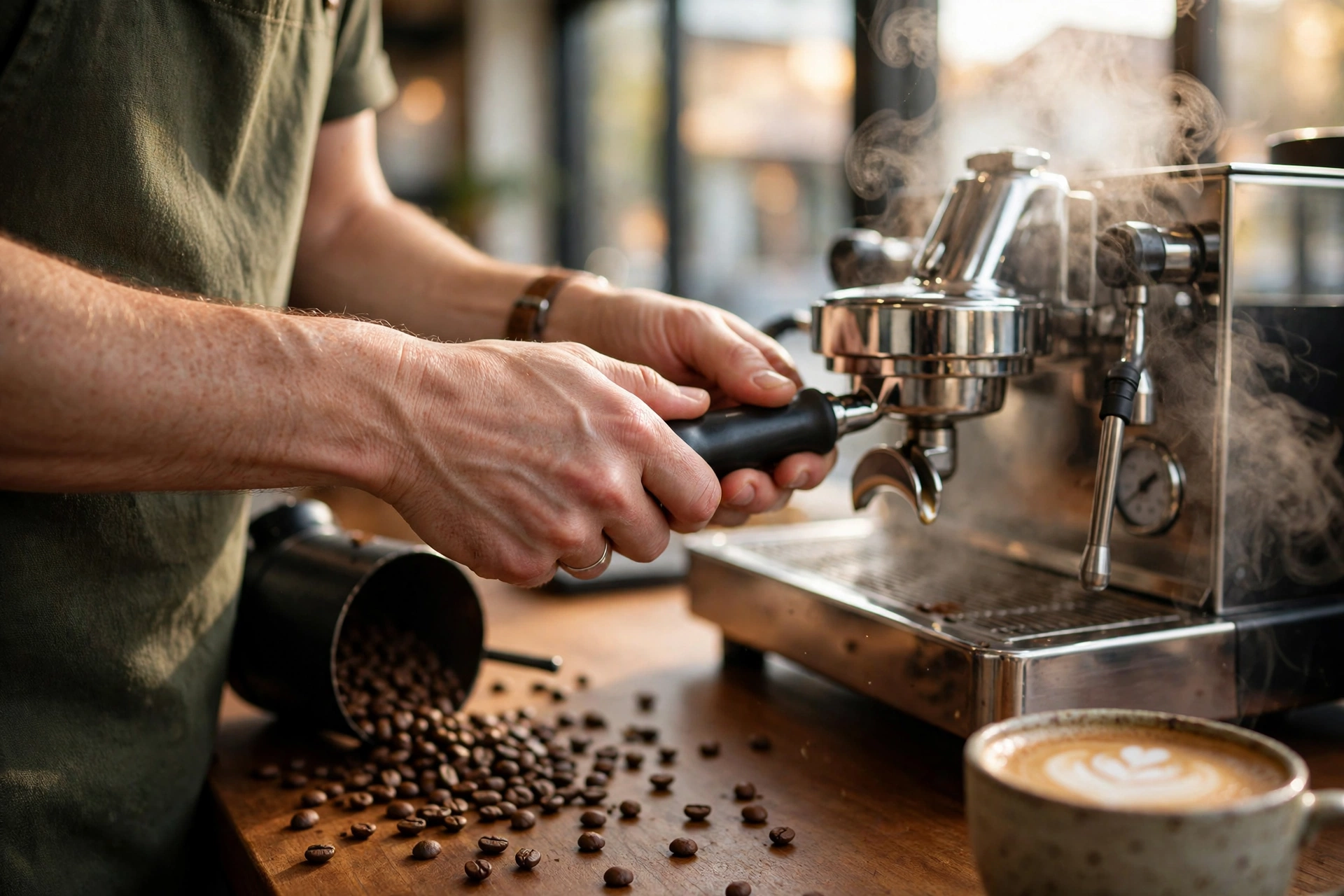
- Distribute and Tamp: Use a distribution tool to level the bed, then apply a firm, level tamp. If the tamp is slanted, the water will find the path of least resistance—this is called "channeling"—and result in a sour, uneven shot.
- Time the shot: Start the timer the moment you engage the pump. If it flows too fast (under 20 seconds), grind finer. If it drips slowly (over 35 seconds), grind coarser.
Step 2: Thermal Management
Temperature stability is what separates a professional brew from an amateur one. Ensure your group heads are heated through. If you're using a manual machine, "season" the machine by running a blank shot of water through the portafilter to stabilize the temperature of the metal.
Step 3: Milk Texturing (The Microfoam)
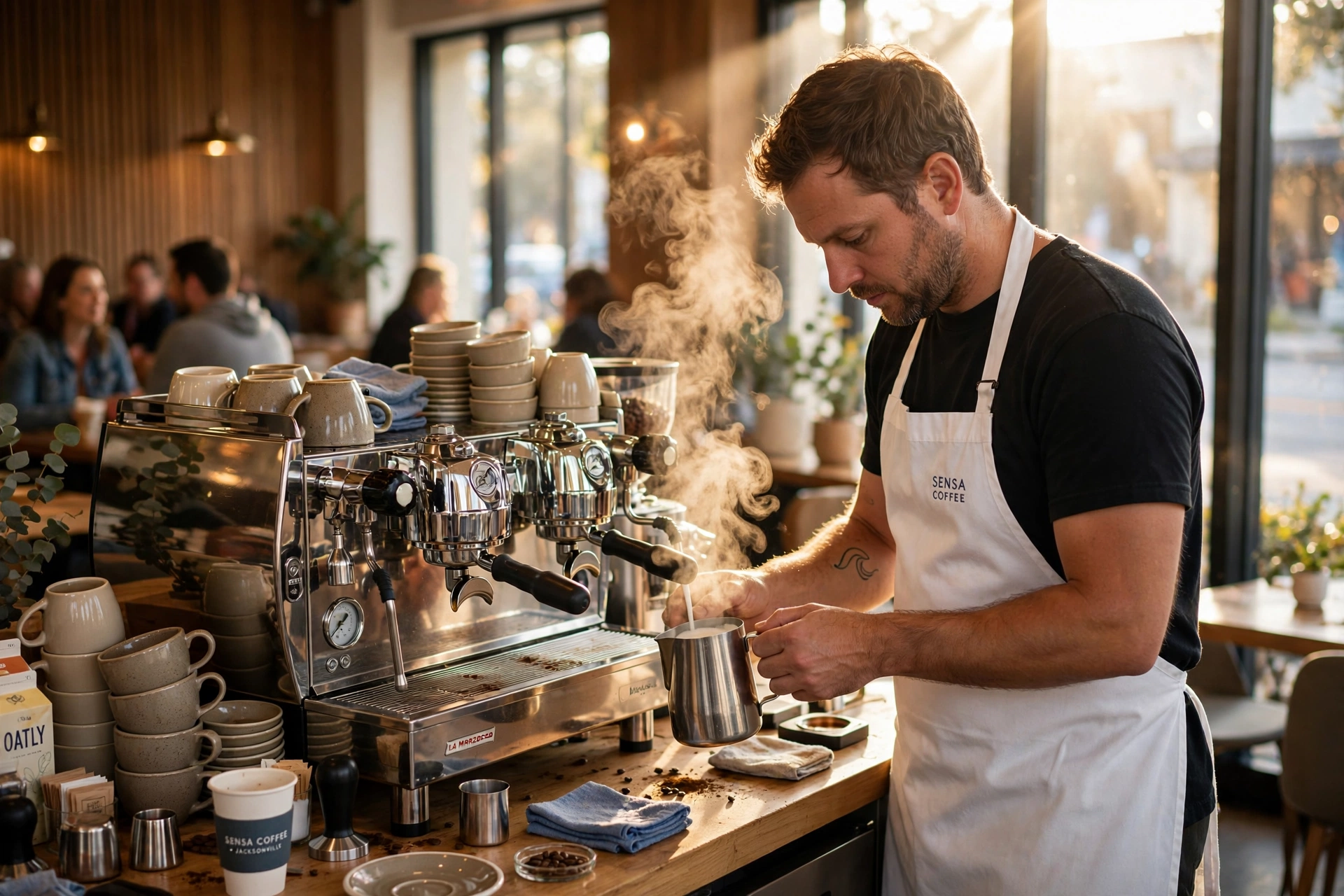
Using a professional steam wand requires a two-stage process: stretching and rolling.
- Stretching: Position the wand tip just below the surface to introduce air, creating a "tss-tss" sound. This builds the volume.
- Rolling: Sink the wand deeper and tilt the pitcher to create a vortex. This incorporates the air bubbles into the milk, creating the glossy, wet-paint texture required for latte art.
Step 4: The Cleanup Cycle
Every hour, purge your steam wand. Every day, perform a chemical backflush. If you ignore this, you are essentially brewing your morning coffee with the leftover oils of yesterday's roast.
💡
Key Takeaway
Consistency is born from measurement. If you aren't weighing your beans and timing your shots, you aren't using specialty coffee equipment—you're guessing.
At Busy Bean Coffee, we simplify this entire process. Our managed solutions provide the SENSA equipment and the professional installation needed to ensure these variables are locked in from day one. We don't just drop off a machine; we ensure your team knows how to maintain that 25-second window and that glossy microfoam.

Choosing the Right Gear: Comparison of Brewing Methods
Depending on your business model—whether it's a high-volume hotel lobby or a boutique cafe—the equipment you choose will change your operational flow. You need to balance speed with quality.
| Equipment Type | Pros | Cons | Best For |
|---|---|---|---|
| Manual Espresso (Lever) | Ultimate control, low electricity | High skill floor, slow speed | Boutique "Slow Coffee" bars |
| Semi-Automatic | Professional quality, repeatable | Requires trained baristas | Specialty Cafes & Restaurants |
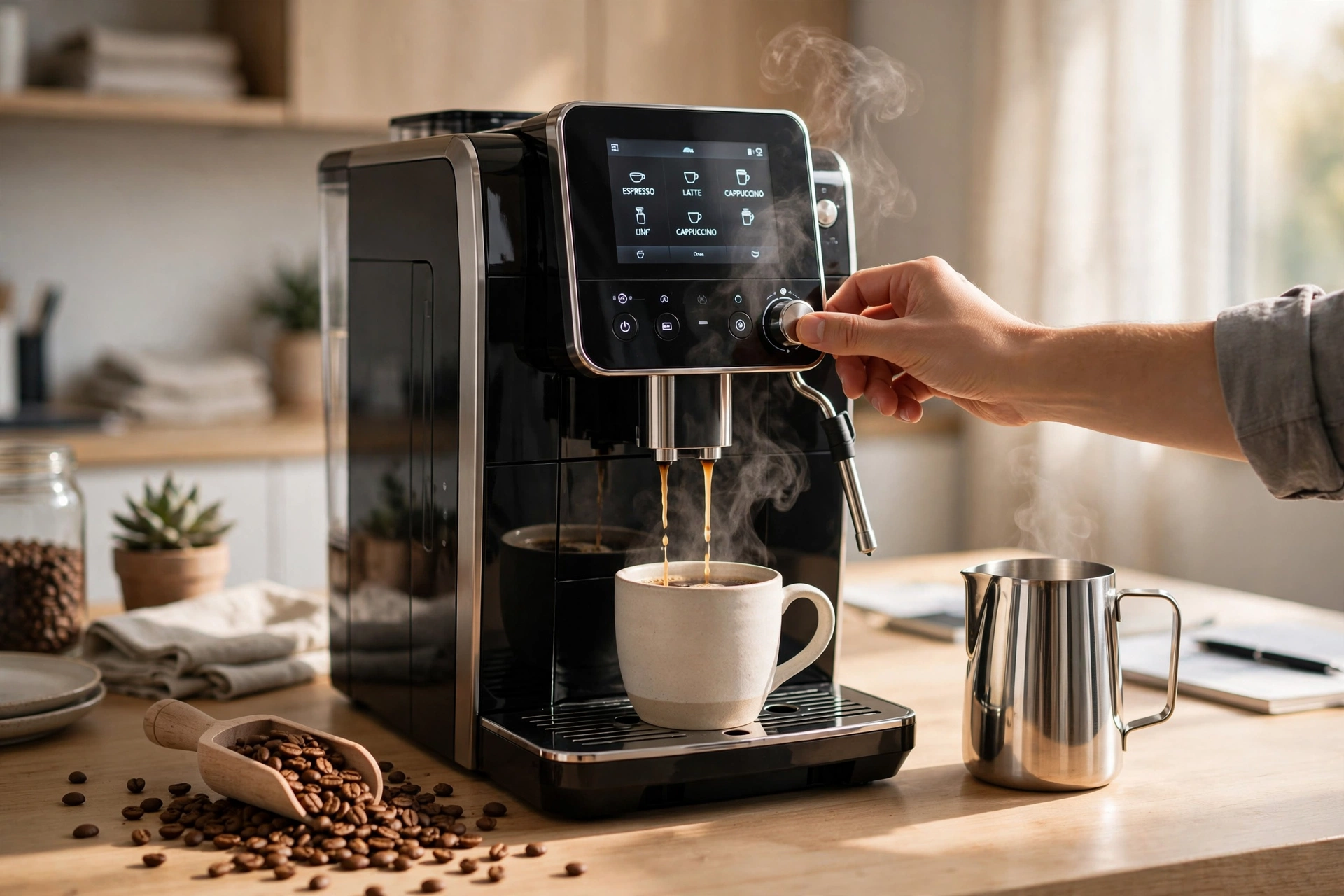
| Super-Automatic | Extreme speed, zero training | Less flavor nuance, high cost | Corporate Offices & Hotels |
| Precision Pour-Over | Highlights origin notes | Very slow, labor intensive | Tasting rooms & Coffee Geeks |
Now, here's where it gets interesting: many businesses make the mistake of buying a semi-automatic machine to look "professional" but don't have the staff to operate it. I've seen this lead to massive frustration and wasted product. If your primary goal is a consistent, high-quality cup without needing a certified barista on every shift, a high-end super-automatic or a managed service is the smarter move.
Common Misconceptions About Specialty Coffee Gear
There is a lot of misinformation in the "coffee influencer" space. Most guides get the fundamentals wrong by focusing on the brand of the machine rather than the science of the extraction.
Myth 1: "The more expensive the machine, the better the coffee."
This is a dangerous assumption. A $15,000 machine operated by someone who doesn't understand grind size will produce worse coffee than a $2,000 machine operated by a pro. The machine is a tool; the skill is the driver.
Myth 2: "Dark roast coffee needs the same settings as light roast."
Incorrect. Darker roasts are more porous and soluble. If you use the same temperature and grind as a light roast, you will over-extract the dark roast, resulting in a harsh, ashy taste. I always recommend dropping the brew temperature slightly for darker roasts.
Myth 3: "Automatic tampers are a gimmick."
Actually, for high-volume businesses, they are a lifesaver. Human error is the biggest cause of inconsistency. An automatic tamper ensures the same pressure every single time, removing the "weak wrist" variable from the equation.
Frequently Asked Questions
How often should I calibrate my specialty coffee equipment?
In a professional setting, you should "dial in" your espresso at least twice a day—once when you open and once after the lunch rush. Coffee beans are organic matter; they react to humidity and temperature changes in the room. If the morning is humid and the afternoon is dry, the beans will swell differently, changing how water flows through the puck. A small adjustment to the grinder's collar can be the difference between a world-class shot and a waste of beans.
Why is my espresso tasting sour even though I'm using expensive equipment?
Sourness is a classic sign of under-extraction. This happens when the water passes through the coffee too quickly, failing to pull out the sweetness and bitterness that balance the acidity. To fix this, you should either grind your coffee finer, increase the dose (add more grams of coffee), or slightly increase the water temperature. Check your timing; if your shot is finishing in 15–20 seconds, you are almost certainly under-extracting.
What is the best way to clean a commercial espresso machine?
Cleaning should happen in three stages: daily, weekly, and monthly. Daily, you must purge the steam wand after every use and backflush with water. At the end of the day, use a specialized espresso detergent (like Cafiza) to backflush the group heads and scrub the shower screens. Weekly, remove the portafilter baskets and soak them in detergent. Monthly, you should check your water filtration system. According to NSF International, maintaining sanitary standards for food equipment is not just about taste—it's about meeting health safety certifications (like NSF/ANSI 4).
Do I really need a separate scale for every brew station?
Yes, absolutely. Volume (measuring by the "line" in the basket) is a lie. Different roasts have different densities; 18 grams of a light roast will take up more physical space than 18 grams of a dark roast. If you measure by volume, your dose will fluctuate, and your extraction time will shift. To achieve the consistency required for specialty coffee, every single dose and every single yield must be measured in grams.
How do I know if my grinder is the problem or my machine?
The easiest way to test this is through a "bypass" test. If you can get a perfect shot using pre-ground professional coffee but your own freshly ground coffee tastes inconsistent or "channelled," your grinder is the culprit. Look for "clumping" in the grounds; if the coffee comes out in chunks rather than a fluffy powder, you likely have a problem with your burr alignment or a lack of a proper dosing system.
Final Thoughts on Specialty Coffee Equipment
Mastering your specialty coffee equipment is a journey of incremental gains. By focusing on the "big three"—grind precision, thermal stability, and rigorous cleaning—you move from simply serving coffee to delivering a curated sensory experience. Remember that the equipment is designed to support the bean, not overshadow it. When you align your workflow with the science of extraction, the results are evident in both the taste of the cup and the loyalty of your customers.
If the technical side of managing these variables feels overwhelming, you don't have to do it alone. At Busy Bean Coffee, we provide an all-inclusive managed coffee membership that takes the guesswork out of the equation. From premium SENSA equipment to professional installation and full maintenance, we ensure your business delivers the perfect cup every single time without the capital headache.
Stop guessing with your extraction. Visit www.busybeancoffee.com to see how we can streamline your coffee service for 2026 and beyond.
Free Coffee Pairing Guide & Specialty Roast Cheat Sheet
Unlock the secrets of perfect brewing ratios, water temperatures, and specialty roast profiles. Download the guide.