How Much Does Managed Coffee Services Cost?
Most business owners I talk to are shocked to find that their "cheap" office coffee setup is actually a silent profit killer. When you factor in the cost of mid-range machines that break every six months, the wasted coffee bean inventory, and the hours staff spend cleaning messy pots, the "low-cost" option becomes an expensive liability. For a professional operation, managed coffee services typically range from a predictable monthly membership fee—often between $200 and $800 depending on volume—to comprehensive per-cup pricing models that eliminate the need for upfront capital expenditure on equipment.
The core value here isn't just the liquid in the cup; it is the transfer of risk. When you move to a managed model, you aren't paying for coffee; you are paying for the guarantee that your espresso machine is always operational, your roasts are consistently fresh, and your overhead is a fixed, predictable line item on your P&L statement.

What Exactly Are Managed Coffee Services and How Are They Priced?
To understand the cost, we first have to define what is actually being managed. Many providers claim to offer "services" when they are really just delivering bags of beans and sending a bill. A true managed service is a holistic partnership where the provider owns the equipment lifecycle and the quality control.
📚
Definition
Managed coffee services is an all-inclusive operational model where a provider supplies the brewing hardware, professional installation, preventative maintenance, and a consistent supply of specialty coffee, typically for a recurring monthly fee or a volume-based contract.
In my experience working with hospitality and corporate clients, the pricing usually falls into three distinct buckets. The first is the Membership Model, which is what we prioritize at Busy Bean Coffee. This involves a flat monthly fee that covers the "everything" factor: the equipment, the maintenance, and a set amount of product. The second is the Lease-to-Own Model, where you pay a monthly fee for the machine and buy the coffee separately. The third is the Cost-Per-Cup Model, common in very high-volume environments, where the provider installs the machine for "free" but charges a premium on every ounce of coffee consumed.
The complexity of pricing often stems from the grade of coffee. If you are using commercial-grade commodity coffee, costs are lower, but your brand perception suffers. If you move toward specialty coffee, which requires stricter sourcing and roasting standards, the cost per pound increases. According to the Specialty Coffee Association (SCA), the rigorous standards for specialty coffee—including scoring 80 points or above on a 100-point scale—require a level of precision in roasting and sourcing that naturally commands a higher price point than mass-market alternatives.
When calculating your budget, you must look beyond the monthly invoice. You have to account for the "hidden" costs of ownership. I've seen businesses spend $5,000 on a high-end machine only to have it sit idle for three weeks because a gasket blew and they didn't have a service contract. In a managed model, that downtime is the provider's problem, not yours.
Why Does the Cost of Managed Coffee Services Matter for Your Bottom Line?
The financial implication of your coffee program extends far beyond the price of a coffee bean. It impacts employee retention, client perception, and operational efficiency. In a corporate or hospitality setting, coffee is often the primary "social lubricant" of the office. When the coffee is poor or the machine is broken, it creates a micro-friction that affects morale.
From a hard-data perspective, the shift to managed services is about converting Capital Expenditure (CapEx) into Operational Expenditure (OpEx). Buying a professional espresso machine and a grinder upfront can easily cost between $10,000 and $25,000. For most small to mid-sized businesses, that is a poor use of liquidity. By utilizing a managed service, you preserve your cash flow for growth-oriented investments while still providing a premium experience.
Furthermore, waste reduction is a massive cost-saver. According to research from the National Coffee Association USA (NCA), consumer preferences are shifting heavily toward high-quality, specialty brews. If your staff is wasting 20% of their brew because it sits in a pot too long, or if they are dialing in a grinder incorrectly and tossing out half a pound of coffee every morning, you are leaking money. Managed services include training for your barista or office manager, ensuring that the extraction is perfect and waste is minimized.
There is also the regulatory cost of safety. Commercial food equipment must meet strict sanitary standards. For example, the NSF International provides the NSF/ANSI 4 standards that ensure equipment is designed to be easily cleaned and prevents contamination. When you manage your own equipment, the burden of ensuring these standards are met through regular descaling and part replacement falls on you. If a health inspector finds a moldy hopper or a scaled-up boiler, the resulting fines and reputation damage far outweigh the monthly cost of a managed service.
How to Implement a Managed Coffee Strategy Step-by-Step
Transitioning to a managed model isn't as simple as signing a contract; it requires an audit of your actual consumption patterns. The mistake I made early on—and that I see constantly—is overestimating the need for a massive, multi-group machine when a high-efficiency automatic system would have sufficed, or vice versa.
Step 1: Conduct a Volume Audit
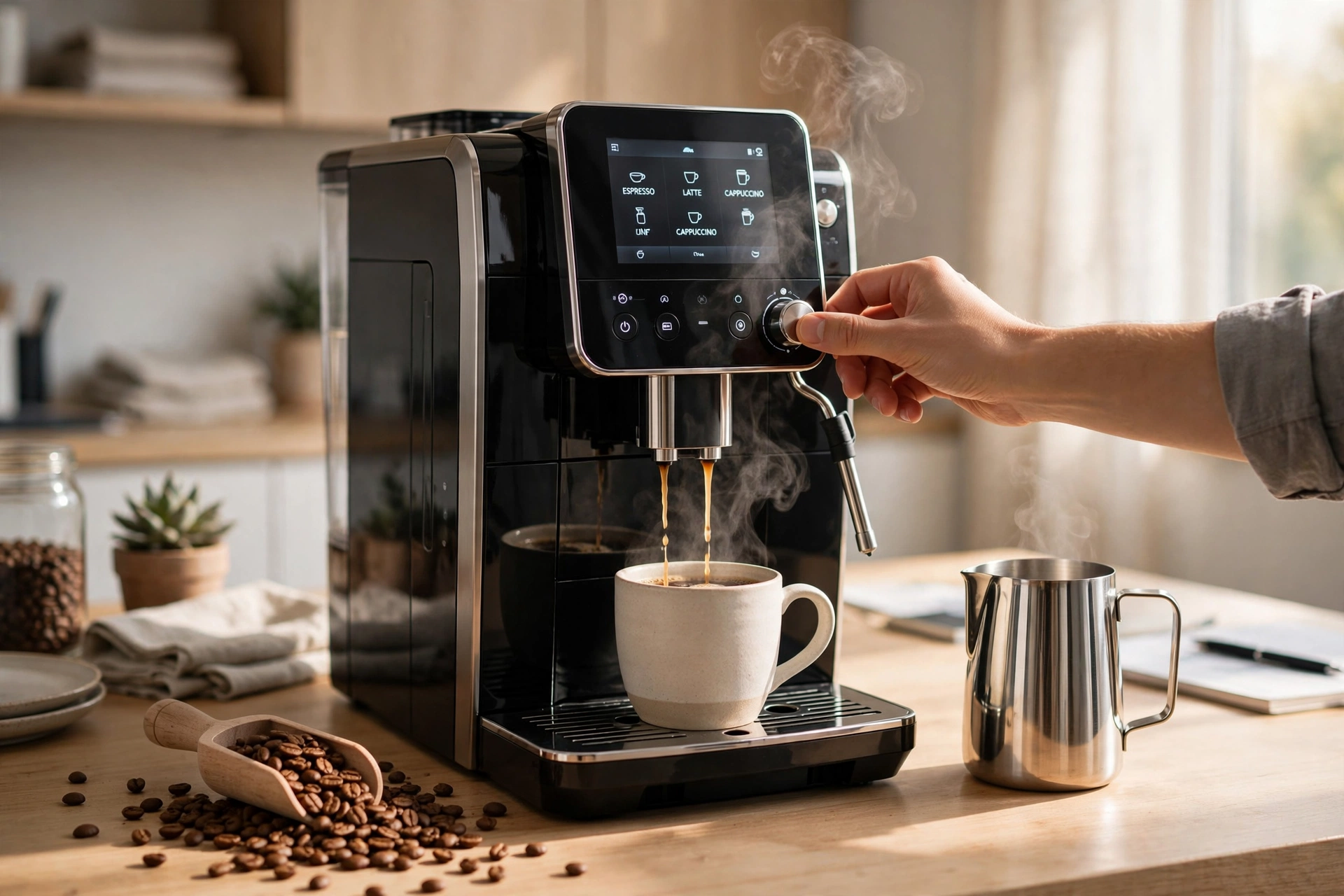
Track how many cups are consumed per day during your peak hours. Are people drinking standard black coffee, or is there a high demand for lattes and cappuccinos? This determines whether you need a bean-to-cup machine or a full semi-automatic setup.
Step 2: Define Your Quality Tier
Decide if you are providing "utility coffee" (meant to wake people up) or "experience coffee" (meant to impress clients). If you want the latter, you need a provider that focuses on Coffea arabica and a precise roasting profile.
Step 3: Evaluate the Service Level Agreement (SLA)
This is the most important part of the cost equation. Does the provider offer 24-hour on-site repair? Do they provide loaner machines? A "cheap" managed service that takes five days to fix a machine is actually more expensive than a premium service because of the lost productivity.
Step 4: Installation and Calibration
Professional installation ensures that your water filtration is correct. In many cities, hard water will destroy an espresso machine boiler in months. A managed service, like the one we provide at Busy Bean Coffee, includes the necessary filtration and initial calibration to ensure the first cup tastes as good as the thousandth.
Step 5: Continuous Training
Coffee is a chemical reaction. The temperature, grind size, and dose must be perfectly aligned. Your managed service should include periodic training for your staff to maintain the quality of the brew.
💡
Key Takeaway
The most cost-effective managed coffee service is not the one with the lowest monthly fee, but the one with the lowest "Total Cost of Ownership," accounting for zero downtime, zero CapEx, and minimal waste.

Comparing Your Coffee Service Options
When deciding how to move forward, you generally have three paths. Most businesses start with the "Traditional" route, realize it's a headache, and then look for a managed solution.
| Feature | Traditional (DIY) | Generic Lease/Rental | Managed Membership (Busy Bean) |
|---|---|---|---|
| Upfront Cost | Very High (Thousands) | Moderate (Deposit) | Zero to Low |
| Maintenance | Your responsibility | Varies by contract | Fully Included |
| Coffee Quality | Inconsistent | Average | Specialty Grade |
| Risk of Downtime | High (Wait for repair) | Moderate | Low (SLA Guaranteed) |
| P&L Impact | Spiky (Repair costs) | Predictable | Fixed Monthly OpEx |
| Best For | Hobbyists/Tiny Offices | Budget-focused firms | Growth-minded businesses |
As the table shows, the "Traditional" approach is a gamble. You are betting that the machine won't break and that your staff will maintain it correctly. The "Generic" approach solves the CapEx problem but often fails on the quality and maintenance front. The "Managed Membership" approach, which we've perfected at Busy Bean Coffee, treats coffee as a utility—like electricity or internet. You pay for the result, not the hardware.
Common Questions and Misconceptions about Coffee Costs
There are several myths circulating in the industry that lead businesses to make poor financial decisions. Most guides get this wrong by focusing only on the price per pound of the coffee bean, rather than the cost of the entire system.
Myth 1: "Buying a cheaper machine saves money in the long run."
This is fundamentally false. Low-end machines use plastic components and cheaper boilers that fail more frequently. In my experience, a $2,000 machine often costs more in repairs and replacement over three years than a $10,000 professional machine does in a managed lease.
Myth 2: "Managed services are only for huge corporations."
Actually, managed services are more critical for small to mid-sized businesses. A Fortune 500 company can afford to have a dedicated facilities manager handle coffee. A 20-person agency cannot. Outsourcing the management allows the business owner to focus on revenue-generating activities rather than fixing a leaky steam wand.
Myth 3: "Specialty coffee is too expensive for daily use."
When you analyze the cost per cup, the difference between commodity coffee and specialty coffee is often just a few cents. However, the difference in employee satisfaction and client perception is massive. High-quality coffee is a low-cost, high-impact perk.
Myth 4: "I can just buy the beans and handle the machine myself."
This ignores the "labor cost of maintenance." Who is descaling the machine? Who is cleaning the group heads? Who is adjusting the grind as the humidity changes? If your most expensive employee is spending an hour a week cleaning a coffee machine, you are losing thousands of dollars in billable time.
Frequently Asked Questions
How much does a typical monthly managed coffee service cost?
For most professional settings, a managed service ranges from $200 to $800 per month. This variance depends on your daily volume, the complexity of the equipment (e.g., a bean-to-cup machine vs. a full semi-automatic espresso machine), and the volume of specialty coffee provided. The goal of this pricing is to create a predictable OpEx line item, removing the stress of sudden, expensive equipment failures or fluctuating bean prices.
Is a managed service cheaper than buying my own equipment?
In the short term, yes, because it eliminates the massive upfront capital expenditure. Over a five-year horizon, a managed service is often more economical because it includes preventative maintenance. Without a managed plan, you pay for the machine once, but you pay for repairs, gaskets, filters, and technician call-out fees indefinitely. Managed services wrap these costs into one fee, preventing "budget shock" when a major component fails.
What is included in an "all-inclusive" coffee membership?
A true all-inclusive membership, such as the one offered by Busy Bean Coffee, includes the professional-grade equipment, professional installation, all necessary water filtration systems, ongoing preventative maintenance, and a consistent supply of premium roasted beans. It also typically includes staff training to ensure your barista or team is using the equipment correctly to maximize the lifespan of the hardware and the flavor of the coffee.
How do you calculate the ROI of a managed coffee service?
ROI is measured by combining three metrics: the elimination of CapEx, the reduction in staff labor hours spent on maintenance, and the increase in "employee wellness" or client satisfaction. If your team spends 4 hours a month dealing with coffee issues at $50/hour, that's $200 in lost productivity. When you add the cost of machine downtime and wasted product, the managed service often pays for itself simply by recovering lost labor.
Does the cost change based on the type of coffee beans used?
Yes, there is a price difference between commodity-grade coffee and specialty coffee. Specialty beans, which are often Coffea arabica sourced from high-altitude regions with strict quality controls, cost more to produce and roast. However, most managed services offer tiered plans, allowing you to choose a roast profile that fits your budget while still maintaining a standard of quality far above what you would find in a grocery store.
Final Thoughts on Managed Coffee Services
When you step back and look at the numbers, the cost of managed coffee services is not about the price of the beans—it is about the price of peace of mind. Running a business is hard enough without worrying if your coffee machine is going to fail during a critical client meeting or if your staff is wasting 15% of your inventory due to poor calibration.
By shifting to a managed model, you replace uncertainty with a predictable monthly investment. You ensure that your team has access to the highest quality specialty coffee, your equipment is maintained to the strictest industry standards, and your capital remains where it belongs: in your growth strategies.
If you are tired of the "DIY" struggle and want a professional, end-to-end beverage solution for your business, we can help. At Busy Bean Coffee, we specialize in taking the hassle out of high-end coffee.
Visit us at www.busybeancoffee.com to explore our managed membership options and start serving a better cup today.
Recommended Readings
To deepen your understanding of these topics, we recommend reading the following articles:
- The Complete Guide to White Glove Coffee Service
- Ultimate Guide to All-Inclusive Coffee Service for Businesses
- Ultimate Guide to Automated Coffee Machines for Business
- Ultimate Guide to Specialty Coffee Equipment for Business
Free Coffee Pairing Guide & Specialty Roast Cheat Sheet
Unlock the secrets of perfect brewing ratios, water temperatures, and specialty roast profiles. Download the guide.