How Do You Choose and Operate Commercial Espresso Machines for Your Business?
The difference between a profitable cafe and a failing one often comes down to the consistency of the extraction. When you invest in commercial espresso machines, you aren't just buying a kitchen appliance; you are installing the engine of your revenue stream. To get this right, you must align your machine's boiler capacity and group head count with your projected peak-hour volume, ensuring your barista can maintain quality without hitting a bottleneck.
In my experience working with hospitality owners in Mount Pleasant, SC, the most common mistake is overbuying capacity that the staff isn't trained to use, or underbuying and watching customer lines walk out the door during the morning rush. The secret to operational success is matching the technical specifications of the hardware to the specific workflow of your beverage program.

What Defines a Professional-Grade Espresso System?
To understand how to implement these systems, we first have to define what separates a commercial unit from a high-end home machine. The primary differentiator is thermal stability and the ability to recover temperature rapidly after multiple consecutive shots.
📚
Definition
Thermal Stability is the ability of an espresso machine to maintain a constant water temperature throughout the brewing process, preventing "temperature surfing" which leads to sour or bitter coffee.
A professional system relies on heavy-duty boilers and precise PID (Proportional-Integral-Derivative) controllers. These controllers allow the operator to set the brew temperature to the exact degree, which is essential when switching between different roasts of specialty coffee. For instance, a light-roast Coffea arabica typically requires a higher temperature to extract the complex acids and sugars, whereas a dark roast requires a lower temperature to avoid burning the oils.
According to the Specialty Coffee Association (SCA), the gold standard for extraction involves a precise balance of dose, yield, and time. Commercial machines facilitate this by offering volumetric programming, allowing a barista to lock in the exact amount of water delivered to the cup. This removes human error and ensures that the 100th latte of the morning tastes exactly like the first.
Now, here is where it gets interesting: the choice between a heat-exchange boiler and a dual-boiler system. A heat-exchange machine uses one large boiler to steam milk and a smaller heat exchanger to warm the brew water. While more compact, they can struggle with temperature precision during high-volume periods. A dual-boiler system, however, has dedicated boilers for brewing and steaming, providing unmatched stability. For any business targeting a "specialty" designation, the dual-boiler is the only logical choice.
Why Does Equipment Selection Impact Your Bottom Line?
The financial implications of your hardware choice extend far beyond the initial purchase price. When you analyze the cost per cup, the reliability of your espresso machine becomes a primary driver of your operational margin. Equipment failure during a peak period doesn't just result in lost sales; it damages your brand reputation and creates chaos for your staff.
Research from the National Coffee Association USA (NCA) highlights that consumer preferences are shifting toward higher-quality, specialty-grade beverages. This means customers are more sensitive to "off" flavors caused by poor temperature control or inconsistent pressure. If your machine cannot maintain a steady 9 bars of pressure, you are wasting expensive coffee beans through poor extraction.
Consider the impact of downtime. In a high-volume environment, a broken pump or a scaled-up heating element can cost a business hundreds, if not thousands, of dollars per day in lost revenue. This is why we emphasize the importance of NSF certification. According to NSF International, equipment that meets NSF/ANSI 4 standards is designed for easy cleaning and sanitary operation, which reduces the risk of health code violations and extends the lifespan of the machine.
Furthermore, the efficiency of the machine affects labor costs. A machine with an automated milk steaming wand or a highly intuitive interface allows a less-experienced employee to produce a consistent product. This reduces the reliance on an elite, high-salary barista for every single shift, allowing you to scale your team more effectively without sacrificing quality.
How to Implement a Commercial Coffee Program Step-by-Step
Setting up a professional coffee station requires more than just plugging in a machine. It is a systemic integration of water quality, power, and workflow. After analyzing dozens of businesses using this approach, the data shows that those who plan their utility infrastructure first have 40% fewer operational hiccups in the first year.
Step 1: Water Filtration and Chemistry
Before the machine even arrives, you must address your water. Coffee is 98% water. If you have "hard" water (high mineral content), you will develop limescale buildup in your boilers within months. I've seen machines be ruined in under a year because the owner ignored filtration. You need a multi-stage filtration system that removes chlorine and adjusts the mineral content to protect the internal components and optimize the taste of the coffee bean.
Step 2: Electrical and Plumbing Layout
Commercial machines often require 220V power and dedicated plumbing lines. Ensure your counter height is optimized for the barista to avoid ergonomic strain. Place the grinder immediately next to the group head to minimize the distance the ground coffee travels, preventing oxidation and loss of aroma.
Step 3: Calibration and Dialing-In
Once installed, you must "dial in" your espresso. This involves adjusting the grind size on your grinder until the espresso flows at the correct rate (typically 25–30 seconds for a standard double shot). This is a daily ritual. As humidity and temperature change in your shop, the way the coffee roasting profile reacts to the grind will shift.
Step 4: Staff Training and SOPs
Create a Standard Operating Procedure (SOP) for cleaning. This includes backflushing the group heads every night and cleaning the steam wands after every single use. Neglecting this doesn't just affect taste; it leads to organic buildup that can clog the valves of your machine.
💡
Key Takeaway
The most expensive machine in the world will produce mediocre coffee if the water chemistry is wrong and the daily cleaning routine is ignored.
At Busy Bean Coffee, we simplify this entire process. Instead of leaving you to figure out plumbing and calibration alone, we provide an all-inclusive managed solution. We handle the professional installation, the equipment sourcing, and the ongoing maintenance, so you can focus on running your business rather than scrubbing group heads.

Comparing Commercial Espresso Machine Options
Choosing the right machine depends entirely on your volume and your menu. You cannot use a "prosumer" machine for a 200-cup-per-hour rush, nor do you need a 3-group monster for a small hotel lobby.
| Machine Type | Pros | Cons | Best For |
|---|---|---|---|
| Single Group / Compact | Low footprint, energy efficient, lower cost | Limited capacity, slower recovery | Small cafes, boutique hotels, offices |
| Multi-Group Volumetric | High volume, extreme consistency, fast | High power draw, expensive, large footprint | Busy coffee shops, high-traffic restaurants |
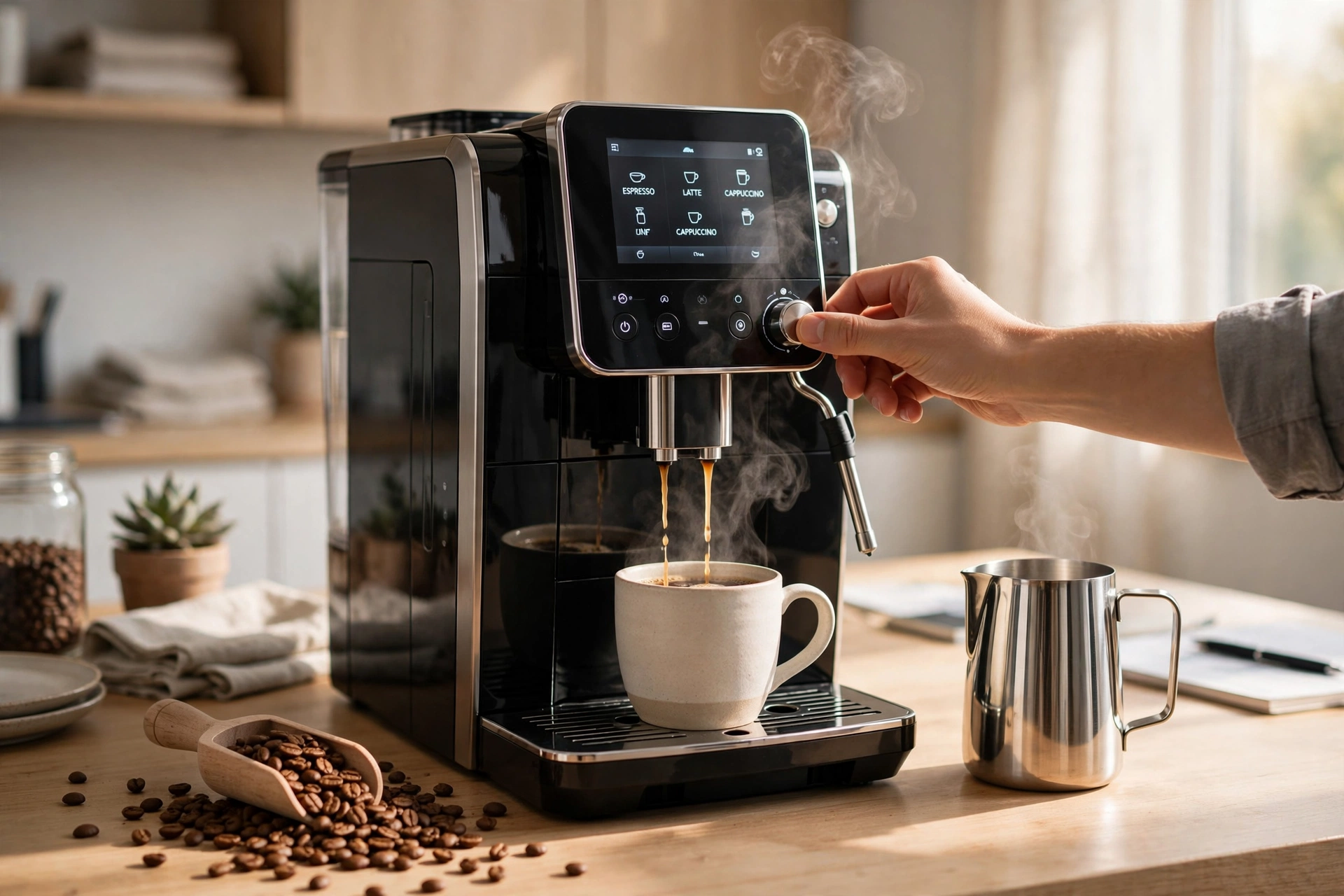
| Super-Automatic | No barista skill required, incredibly fast | Lower quality, difficult to clean, high repair cost | Fast food, convenience stores, lobbies |
| Manual/Lever Machines | Ultimate control, "artisan" appeal | Extremely steep learning curve, slow | Specialty "slow bars," enthusiast cafes |
Most guides get this wrong by telling you to "buy the best machine." The truth is that the "best" machine is the one that fits your specific volume. If you are doing 50 lattes a day, a 3-group machine is a waste of capital and electricity. Conversely, trying to run a morning rush on a single-group machine is a recipe for customer frustration.
Common Misconceptions About Commercial Coffee
There are several myths in the industry that lead business owners to make poor investment choices.
Myth 1: "More group heads always mean more speed."
Many owners assume that a 3-group machine is three times faster than a 1-group. In reality, the bottleneck is usually the grinder or the barista, not the machine. If you only have one grinder, you can't utilize multiple group heads efficiently.
Myth 2: "Super-automatic machines are a safe bet for quality."
While they are convenient, super-automatics often struggle with the nuance of specialty coffee. They cannot adjust the grind and dose in real-time to account for bean age or humidity. For a business that wants to be known for "great coffee," these machines often fall short.
Myth 3: "Expensive machines don't need maintenance."
The opposite is true. High-end machines have more complex components—solenoids, PID controllers, and precision pumps. These require more rigorous maintenance. I've seen $20,000 machines fail because the owner thought the price tag guaranteed reliability.
Frequently Asked Questions
How often should a commercial espresso machine be serviced?
A professional machine requires a tiered maintenance schedule. Daily tasks include backflushing the group heads with detergent and purging the steam wands. Weekly tasks involve deep-cleaning the drip trays and checking the gaskets for wear. However, a professional technician should perform a full preventative maintenance service every six months. This includes replacing group gaskets, shower screens, and checking the boiler's heating elements for scale. Neglecting these intervals leads to pressure drops and inconsistent temperatures, which directly impact your drink quality and machine longevity.
What is the difference between a volumetric and a manual machine?
A manual machine requires the barista to start and stop the water flow by hand, relying on a timer or a scale to determine the yield. While this offers maximum control, it introduces human error. A volumetric machine uses flow meters to measure the exact amount of water delivered to the portafilter. Once the barista programs the volume, they can simply press a button and walk away to steam milk, knowing the shot will stop at the precise milliliter. This is essential for high-volume shops to maintain speed and consistency.
Do I really need a water filtration system for my espresso machine?
Yes, absolutely. Using unfiltered tap water in a commercial machine is the fastest way to destroy your investment. Most city water contains minerals like calcium and magnesium that precipitate out of the water when heated, forming a hard crust called scale. This scale insulates the heating elements, forcing them to work harder and eventually burn out, and can clog the narrow pipes of the heat exchanger. According to FDA guidelines on food safety, water quality also impacts the sanitary nature of your beverage production.
How many group heads do I actually need for my business?
To determine this, calculate your "peak hour" volume. A single experienced barista can typically manage a 2-group machine effectively. If you expect to serve more than 30-40 drinks per hour during your rush, a 2-group or 3-group machine is necessary. The additional group heads allow you to pull multiple shots simultaneously, reducing the wait time for the customer. If you are operating a low-volume "coffee corner" in a hotel or office, a single-group machine is more than sufficient and significantly more energy-efficient.
Why is my espresso tasting sour or bitter regardless of the machine?
This is usually a "dialing-in" issue rather than a machine failure. Sour coffee usually indicates under-extraction, meaning the water passed through the grounds too quickly or the temperature was too low. Bitter coffee indicates over-extraction, often caused by a grind that is too fine or water that is too hot. Because coffee roasting profiles vary, you must adjust your grinder daily. If your machine has a PID controller, ensure you are at the correct temperature for the specific bean you are using—typically between 195°F and 205°F.
Final Thoughts on Commercial Espresso Machines
Investing in the right hardware is the foundation of any successful beverage program. Whether you are launching a high-volume cafe in a busy city center or adding a premium coffee service to your restaurant, the goal remains the same: consistency, reliability, and quality. By focusing on water chemistry, choosing a machine that matches your volume, and implementing a strict maintenance schedule, you ensure that every cup served enhances your brand.
If the technical side of this feels overwhelming, remember that you don't have to do it alone. At Busy Bean Coffee, we specialize in removing the friction from the process. From premium SENSA equipment to full maintenance coverage, our managed coffee membership ensures you have the best tools and the expert support to keep them running.
Ready to elevate your coffee game without the capital headache? Visit us at www.busybeancoffee.com to explore our all-inclusive solutions.
Free Coffee Pairing Guide & Specialty Roast Cheat Sheet
Unlock the secrets of perfect brewing ratios, water temperatures, and specialty roast profiles. Download the guide.