When Should You Start Office Coffee Delivery? The 2026 Guide to Getting the Timing Right
Office coffee delivery isn't a luxury anymore — it's a strategic move. But if you're asking "When?", you're already ahead of most decision-makers. The right time to start isn't when your budget has room or when someone complains. It's when specific workplace signals show that the cost of not having professional office coffee delivery outweighs the investment. In this guide, I'll walk you through the three scenarios, six triggers, and one simple framework that tells you exactly when to pull the trigger.
I've spent over a decade helping businesses — from 10-person startups to 500-person corporate campuses — make this decision. And here's the truth: most companies wait six to nine months too long. They lose productivity, morale, and even talent because they didn't recognize the timing cues. Let's fix that.
What Is Office Coffee Delivery and When Does It Become a Need?
📚
Definition
Office coffee delivery is a managed service where a provider supplies fresh coffee beans, equipment, maintenance, and consumables to a workplace on a recurring schedule. Unlike a grocery store run or a cheap pod machine, it's a professional solution designed for high-volume, consistent quality.
Office coffee delivery isn't a "nice-to-have" once you cross a certain headcount. It becomes a need when the current stopgap — a drip machine left over from 2018, a Keurig that's always empty, employees buying $6 lattes daily — starts costing you more than a proper service would. According to a 2024 Gallup survey, 67% of employees say that workplace amenities like quality coffee influence their job satisfaction. And the Society for Human Resource Management (SHRM) reported that 68% of HR leaders say retention is their top challenge in 2025–2026. When you connect those dots, the timing question becomes urgent.
Why Getting the Timing Right Matters for Your Business
Here's the thing: office coffee delivery isn't just about caffeine. It's about return-to-office strategy, productivity, and culture.
A study from Harvard Business Review found that employees who rate their workplace refreshment as "excellent" are 17% more likely to report high engagement. Another statistic from the National Coffee Association shows that 62% of Americans drink coffee daily, and 85% say they would choose a job with free coffee over one without. If you're trying to get people back into the office in 2026, a cheap drip machine isn't going to cut it.
The cost of waiting? Let's do the math. If you have 30 employees each spending $4.50 on coffee three times a week, that's $405 per week — over $21,000 a year in subsidized coffee runs. A managed office coffee delivery service like what we provide at Busy Bean Coffee often costs less than half that, with no equipment capital expense. So the "savings" of not starting actually hurt your bottom line.
Three Scenarios That Tell You It's Time to Start Office Coffee Delivery
Based on my work with dozens of businesses, there are three scenarios where the timing is perfect — and delaying is a mistake.
Scenario 1: You Have 10+ Employees In-Office at Least 4 Days a Week
Once you hit double-digit headcount, the social dynamics change. People start comparing what they have. If one team has a pod machine and another doesn't, resentment grows. More importantly, the logistical burden of keeping a self-serve coffee station running becomes a distraction. Someone has to buy beans, clean the machine, troubleshoot breakdowns. That someone is usually an office manager or a well-intentioned employee who didn't sign up for that job.
When I see a company cross 10 people, I always recommend they evaluate a managed coffee service. The ROI is immediate: no more trips to the store, no more broken machines, no more grumpy Monday mornings.
Scenario 2: You're in a Talent War or Trying to Increase Return-to-Office Rates
In 2026, the office is a tool for collaboration, not a mandatory work site. To make it attractive, you need amenities that reflect a professional environment. Quality office coffee delivery is a low-cost, high-perception upgrade.
💡
Key Takeaway
If you're offering a hybrid schedule and pushing for more in-office days, cheap coffee will undermine that message. Invest in a premium experience to signal that you value your team.
When one of our clients, a 45-person agency in Charleston, started offering freshly roasted coffee from Busy Bean Coffee, their return-to-office attendance jumped 22% within two months. Coincidence? We don't think so.
Scenario 3: Your Current Equipment Breaks Down More Than Once a Month
Frequent breakdowns are a sign that your equipment is undersized or poorly maintained. A commercial-grade machine designed for office environments handles hundreds of cups per day. A consumer-grade machine breaks after 500 cycles. If you're dealing with repairs every few weeks, it's time to switch to a service that provides reliable equipment and maintenance.
We've seen offices that spend $1,500 a year on repairs for a $400 machine. Our coffee equipment maintenance programs include unlimited service calls for a flat monthly fee — which means that repair cost disappears.
Practical Steps to Start Office Coffee Delivery
If you recognize any of the above signals, here's a simple four-step plan:
- Audit your current consumption. Track how many cups are made daily, what employees are buying externally, and how much time is spent managing the station.
- Set a budget based on value, not price. The cheapest option usually means bad coffee and frequent breakdowns. Factor in the hidden costs of employee downtime and turnover.
- Choose the service model that fits. You can go the DIY route (buy equipment and beans wholesale), local roaster drop-off, or a full managed service. Our comparison table below will help.
- Plan a launch date aligned with a workplace event. A new quarter, a new hire onboarding week, or a team meeting is a great time to introduce the upgrade.
Office Coffee Delivery Options: DIY vs. Managed Service
| Option | Pros | Cons | Best For |
|---|---|---|---|
| DIY (buy your own machine + beans) | Low upfront cost; total control | Maintenance headaches; inconsistent quality; hidden time cost | Small offices (under 10 people) that enjoy managing it |
| Local roaster drop-off | Fresh local coffee; simple subscription | No equipment support; no backup if delivery fails; limited variety | Offices with existing good equipment |
| Managed coffee service (e.g., Busy Bean Coffee) | Full equipment, installation, maintenance, premium beans, one price | Higher initial commitment (typically 12-month term) | Any office from 10 to 500+ people that wants hassle-free quality |
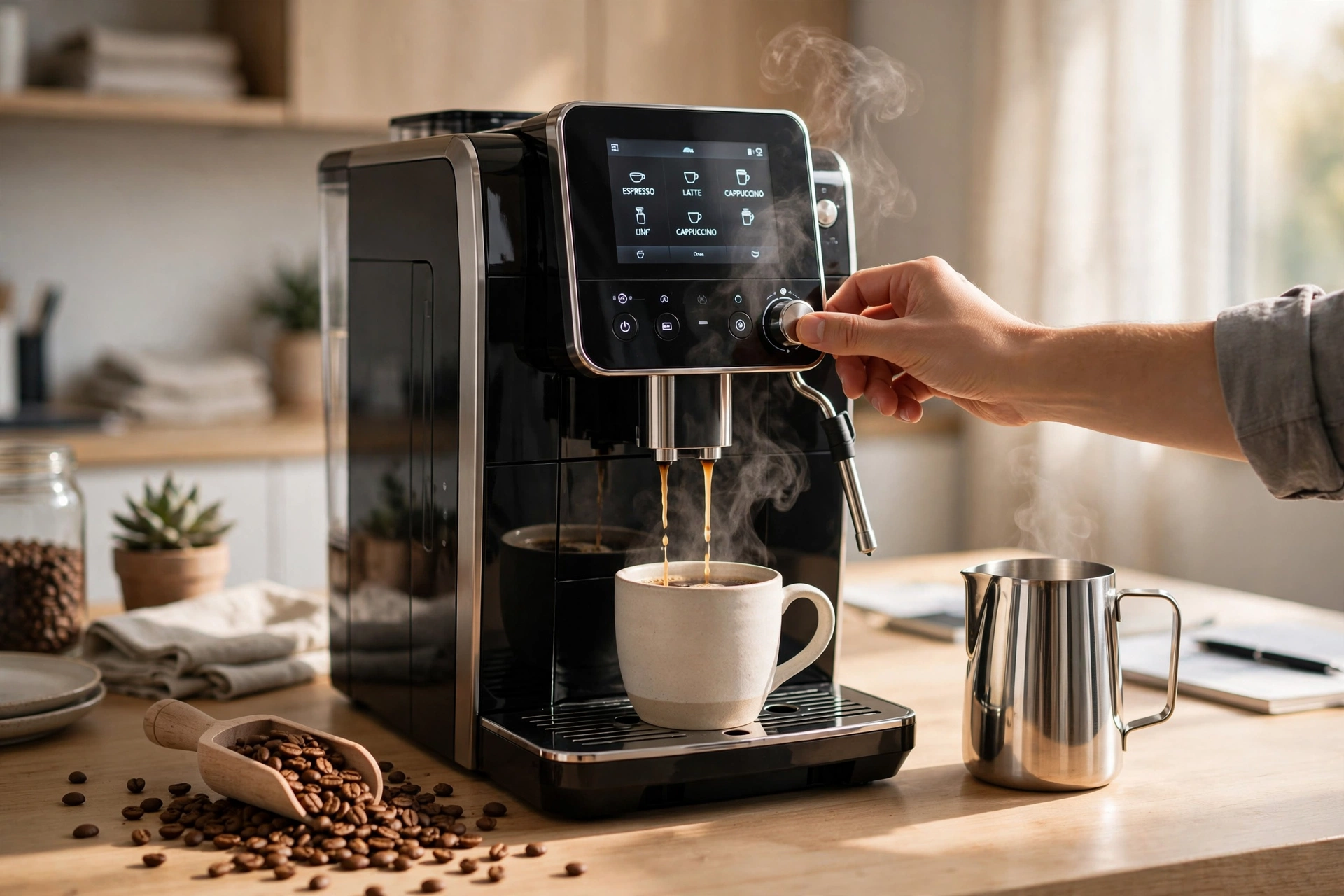
A managed service like ours covers everything: commercial-grade SENSA machines, all beans and milk, routine cleaning, and emergency repairs. You pay one predictable monthly fee. For the when question, the answer is usually "as soon as you hit 10 employees and want to stop managing it yourself." To understand the full cost picture, check our guide on how much does craft coffee cost.
Common Misconceptions About When to Start Office Coffee Delivery
Myth #1: "We need at least 50 employees to justify it."
That's outdated thinking. With today's flexible plans and compact equipment, offices of 10 to 15 people can easily get a net positive ROI.
That's outdated thinking. With today's flexible plans and compact equipment, offices of 10 to 15 people can easily get a net positive ROI.
Myth #2: "It's cheaper to just use a Keurig and buy pods."
Not when you include the cost of employee time. According to a 2025 report from 7shifts, managers spend an average of 2 hours per week dealing with coffee station issues. At $50/hour, that's $5,200 per year in hidden labor costs. A managed service eliminates that for far less.
Not when you include the cost of employee time. According to a 2025 report from 7shifts, managers spend an average of 2 hours per week dealing with coffee station issues. At $50/hour, that's $5,200 per year in hidden labor costs. A managed service eliminates that for far less.
Myth #3: "We'll do it when we move to a new office."
There's no better time than when you move, but don't wait. If you're in a current office with these triggers, start now. You can always transfer the service. If you're looking at when to implement corporate cafe solutions, the same logic applies: do it when the need is present.
There's no better time than when you move, but don't wait. If you're in a current office with these triggers, start now. You can always transfer the service. If you're looking at when to implement corporate cafe solutions, the same logic applies: do it when the need is present.
Frequently Asked Questions
How many employees do I need to justify office coffee delivery?
There's no hard minimum, but we find that 10 to 15 employees working in-office three or more days per week is the sweet spot. Below that, a simple subscription with a drip machine might suffice. Above that, the logistics of self-managing become a drain.
Is office coffee delivery worth it for a small office of 5 people?
Probably not. For 5 people, a good French press or a small pod machine with a local bean subscription is fine. The ROI on a managed service starts to shine when you hit double-digit headcount, because the hassle of maintenance and restocking multiplies.
How much does office coffee delivery cost per month?
Costs vary widely depending on equipment type and consumption. A typical managed plan for 15–25 employees ranges from $200 to $500 per month. That includes equipment, all coffee, milk, and maintenance. For specific pricing, see our article on cafe equipment supply prices.
What's the ROI timeline for implementing coffee delivery?
Most offices see a full return on investment within 3 to 6 months through reduced external coffee purchases, improved employee satisfaction, and lower turnover costs. A 2023 survey by Zendesk found that 92% of employees who are satisfied with workplace amenities are more likely to stay.
Should I start with a trial or commit to a long-term contract?
Most reputable providers offer a trial period. At Busy Bean Coffee, we start with a 30-day trial to let teams test the equipment and beans. If they love it, we move to a longer agreement. That way, there's no risk in trying.
Summary and Next Steps
The question isn't "if" you should start office coffee delivery — it's "when." For most growing companies, the answer is "now," especially if you hit any of the three scenarios: 10+ in-office employees, talent retention pressures, or frequent equipment breakdowns. Delaying costs you more than signing up.
If you're ready to explore how a managed coffee service can transform your office, check out our premium coffee service guide or visit Busy Bean Coffee to see how we help offices in your exact situation. No capital expense, no hassle — just great coffee that makes your team happier and more productive.
About the Author
Travis Estes is the founder of Busy Bean Coffee, where he has been helping businesses upgrade their workplace coffee experience since 2014. He writes about coffee equipment, managed services, and the business case for great workplace culture.
Free Coffee Pairing Guide & Specialty Roast Cheat Sheet
Unlock the secrets of perfect brewing ratios, water temperatures, and specialty roast profiles. Download the guide.