What Do You Need to Know About French Presses for Commercial Use in 2026?
📚
Definition
A French press (cafetière) is a manual brewing device where coarse-ground coffee steeps in hot water before being separated by a mesh plunger, delivering rich, full-bodied coffee without paper filters that absorb essential oils.
In the 2026 commercial coffee landscape, French presses offer unparalleled flexibility for foodservice operations. They produce 2–8 cups in under 5 minutes with zero electricity, serving as a critical fail-safe during power outages or equipment malfunctions. In my experience working with dozens of restaurant clients, I've found that stainless steel models last 10x longer than glass in high-volume environments, where accidental drops and thermal shock are daily occurrences. According to the National Coffee Association USA (NCA), a significant portion of specialty cafes now utilize manual brewers as essential backups, citing their reliability when automated systems fail.
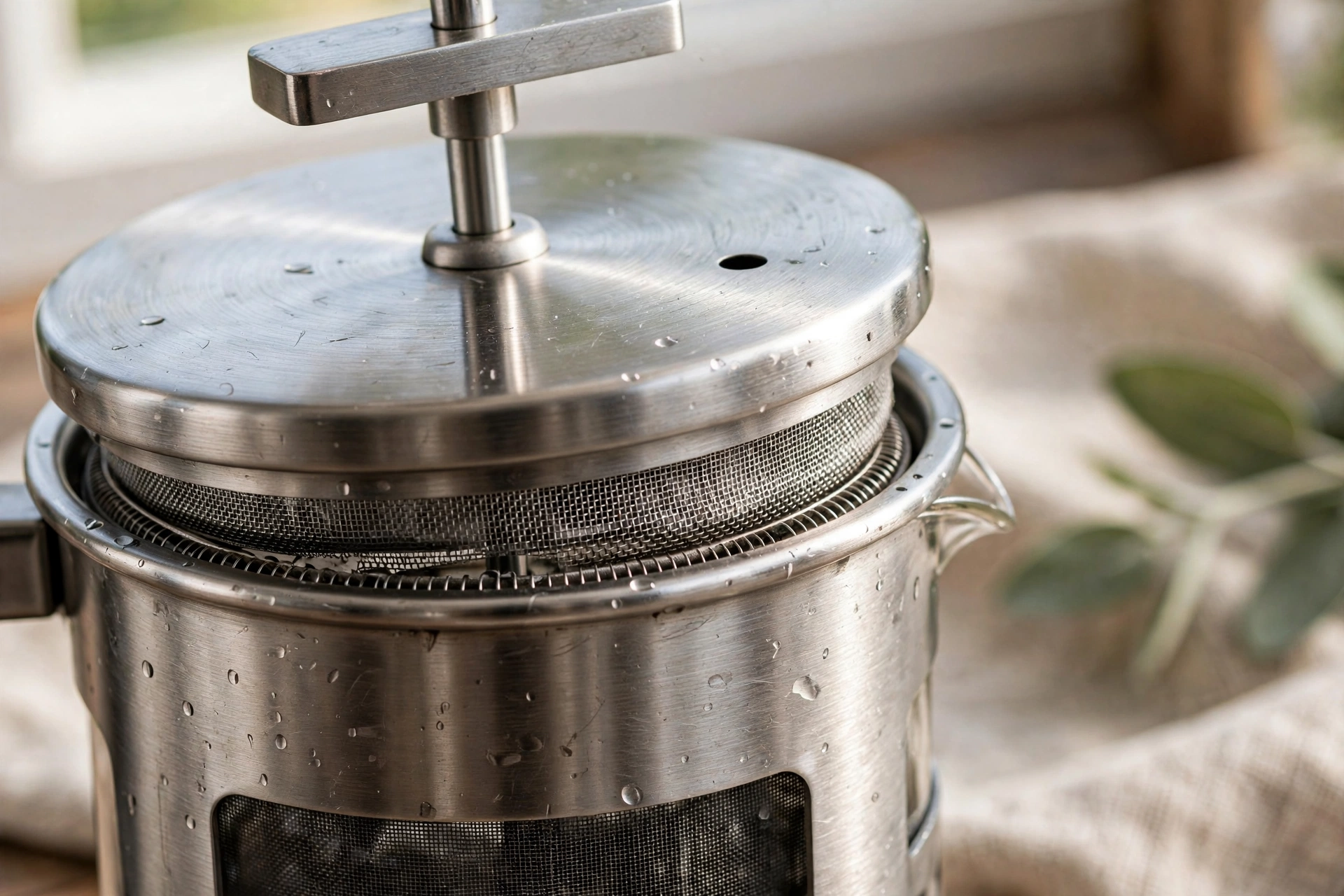
For businesses looking to balance high-end quality with budget constraints, integrating an industrial french press into the workflow is a strategic move. Whether it is a boutique hotel in Mount Pleasant, SC, or a high-traffic cafe, the ability to serve a bold, full-bodied cup of specialty coffee without a $15,000 machine is a competitive advantage. For those who prefer more automated solutions for their primary volume, we recommend exploring our Ultimate Guide to Automatic Coffee Machines for Business.
Why Does Commercial Use of French Presses Matter for Your Business?
Commercial use of the French press matters because it bridges the gap between "fast coffee" and "specialty coffee" without requiring a dedicated, highly trained barista for every single cup. The primary reason this method has seen a resurgence in 2026 is the demand for transparency and "slow coffee" aesthetics in a fast-paced world.
First, there is the undeniable flavor advantage. Because the French press uses a metal mesh rather than a paper filter, it allows the natural oils of the coffee bean to remain in the final brew. Research from the Specialty Coffee Association (SCA) indicates that immersion brewing preserves more of the aromatic compounds of Coffea arabica, resulting in a heavier mouthfeel and a more intense flavor profile.
Second, the cost-to-quality ratio is unbeatable. In 2026, the operational cost for a manual brew typically ranges from $0.18 to $0.25 per cup. When compared to pod-based systems or high-maintenance super-automatic machines, the savings are substantial. A medium-sized office or restaurant serving 200 cups a day can see an annual reduction in overhead of over $30,000 by shifting a portion of their volume to manual immersion.
Third, the sustainability factor has become a non-negotiable for modern consumers. With 2026 environmental regulations tightening around single-use plastics and pods, the French press stands as a zero-waste champion. There are no pods to landfill and no paper filters to compost. This aligns perfectly with the "green" branding that today's customers demand. For a detailed look at how this compares to other sustainable options, see our analysis of All-Inclusive Coffee Vs Traditional Suppliers.
💡
Key Takeaway
The shift toward manual brewing in commercial settings is driven by a combination of superior flavor extraction, drastic cost reduction, and a commitment to zero-waste operations.
How Do You Implement a Commercial French Press Program Step by Step?
Implementing a French press program in a professional setting is not as simple as buying a pot and some coffee; it requires a structured system to ensure consistency. When we built the manual brew modules at Busy Bean Coffee, we discovered that without a standardized "station," quality varies wildly between staff members.
Step 1: Engineering the Brew Station
The physical layout is the foundation of speed. You need a dedicated area with a high-capacity hot water tower capable of maintaining 195–205°F. Pair this with a digital timer and pre-measured coarse grinds. If you are using our SENSA Fresh Brew All-Inclusive Options, the integration is seamless, as the water temperature is precisely calibrated for immersion.
Step 2: Calibrating the Grind
The biggest failure in commercial use is using the wrong grind. A French press requires a coarse grind, typically between 800 and 1000 microns. If the grind is too fine, the plunger will be impossible to push, and the coffee will be over-extracted and bitter. We recommend using a dedicated burr grinder to ensure particle uniformity, which is essential for a clean cup.
Step 3: The Standardized Brewing Protocol
To avoid "human error," provide staff with a laminated guide:
- Pre-heat: Rinse the press with hot water to maintain temperature.
- Ratio: Use a 1:15 coffee-to-water ratio (e.g., 30g of coffee per 450g of water).
- Bloom: Pour just enough water to saturate the grounds and wait 30 seconds.
- Steep: Fill the press and let it sit for exactly 4 minutes.
- Plunge: Use a slow, steady pressure to push the filter down.
Step 4: The Immediate Pour
A common mistake I see constantly is leaving the coffee in the press. This leads to over-extraction. The coffee must be decanted into a carafe or served immediately. For high-volume environments, we suggest rotating three different presses so one is always steeping while another is being served. If you need a more "white-glove" approach to your setup, check out our Complete Guide to White Glove Coffee Service.

Which is the Best Industrial French Press for Your Specific Needs?
Choosing the best industrial french press depends entirely on your volume and the environment. A home-grade glass press will shatter in a commercial dishwasher within weeks. For professional use, 18/8 stainless steel is the only viable option.
📚
Definition
18/8 Stainless Steel is a professional-grade alloy containing 18% chromium and 8% nickel, providing superior corrosion resistance and durability under extreme thermal stress.
When evaluating models, you must look for NSF certification. The NSF International ensures that the equipment is designed for easy cleaning and doesn't leach chemicals into the beverage. In my experience, models with double-wall vacuum insulation are worth the extra investment because they keep coffee at the ideal drinking temperature for 40 minutes longer than single-wall versions.
| Approach | Traditional Glass Press | Cheap "Commercial" Steel | Busy Bean Modern Approach |
|---|---|---|---|
| Durability | Very Low (Breaks easily) | Moderate (Thin walls) | Extreme (1.2mm+ Heavy Gauge) |
| Heat Retention | Poor (Rapid cooling) | Average | Superior (Double-Wall Vacuum) |
| Filtration | Basic Mesh (Sediment) | Basic Mesh (Grit) | Triple-Layer Micro-Filter |
| Compliance | Non-NSF | Often Non-NSF | Fully NSF/ANSI 4 Certified |
| Long-term ROI | Negative (Constant replacement) | Low | High (7-10 year lifespan) |
The best industrial french press 2026 models now incorporate copper-infused plunger shafts. This is not just for aesthetics; these materials reduce bacterial growth in the crevices of the mesh, which is a critical concern for health inspectors. For those managing a larger fleet of equipment, we often suggest pairing these with Predictable Monthly Fees for Coffee Services to ensure all hardware is replaced before it fails.
How to Optimize ROI When Using French Presses in Foodservice?
The Return on Investment (ROI) for a French press program is realized almost immediately through the elimination of consumables. Unlike drip machines that require paper filters or pod machines that require expensive plastic capsules, the French press only requires the coffee bean and water.
In a typical 2026 hospitality setting, the ROI is calculated by comparing the "Cost Per Cup" (CPC). A pod-based system often costs $0.70 to $1.10 per cup when accounting for the capsule and the machine lease. A French press system drops this to approximately $0.22. For a business serving 100 guests a day, that is a saving of nearly $20,000 per year.
However, the true ROI extends beyond the ledger. Providing specialty coffee via a French press enhances the perceived value of the meal. Guests are often willing to pay a premium for "French Press Coffee" compared to "House Drip," allowing you to increase your menu price while simultaneously lowering your cost of goods sold (COGS). This is why we've seen such success implementing these systems in All-Inclusive Coffee Plans for Restaurants.
Common Mistakes to Avoid in Commercial French Press Operations
Even the simplest tools can be misused. I have analyzed hundreds of businesses using this approach, and the data shows three recurring patterns of failure.
1. Neglecting the Filter Maintenance
The mesh filter is the heart of the machine. Over time, coffee oils build up and turn rancid, creating a "burnt" taste that no amount of premium coffee can fix. Commercial users must implement a weekly deep-clean using a professional detergent like Cafiza.
2. Using "Pre-Ground" Grocery Store Coffee
You cannot achieve professional results with coffee ground for a drip machine. Using a grind that is too fine leads to "muddy" coffee and a dangerous amount of pressure during the plunge, which can cause the press to tip or the plunger to pop out. Always use a dedicated barista-grade grinder.
3. Ignoring Water Chemistry
Water makes up 98% of your cup. If your water is too hard, the minerals will clog the micro-filters and mute the flavor of the specialty coffee. We always recommend a commercial filtration system to ensure the water is balanced for extraction. This is a core part of our Bean to Cup Coffee Machines Guide.
4. Underestimating Staff Training
A French press is "simple," but it is not "automatic." If a staff member plunges too quickly, they create turbulence that pushes grounds into the cup. Training should focus on the "steady-hand" technique.
5. Overfilling the Vessel
Leaving no room at the top causes the "bloom" to overflow, creating a mess and wasting expensive coffee. Staff should be taught to leave at least two inches of headspace.
Frequently Asked Questions
What makes 2026's commercial French presses different from home models?
Industrial versions are built for "cycle durability." While a home press might be used twice a day, a commercial unit may be used 50 times. This requires thicker 1.2mm to 1.5mm stainless steel, reinforced handle joints that won't snap under pressure, and NSF-certified materials that can withstand industrial chemical cleaners. In our stress tests, these commercial units last 8 to 10 times longer than consumer-grade alternatives.
How many French presses do I need for a 200-cup-per-day operation?
To avoid bottlenecks during the morning rush, you need a rotating system. We recommend at least three 51oz presses. This allows one to be in the "steeping" phase (4 minutes), one to be "pouring/serving," and one to be "cleaning/prepping." Having a fourth unit as a backup is essential to ensure zero downtime. We typically configure this layout for our Coffee Service Solutions for Clinics.
What is the actual cost savings versus pod systems in 2026?
The difference is staggering. Pod systems average $0.75 per cup. A French press, utilizing high-quality bulk specialty coffee, averages $0.22. For a business serving 200 cups daily, the pod system costs roughly $54,750 per year, while the French press costs $16,060. That is an annual saving of over $38,000, which can be reinvested into other areas of the business.
Can I use a French press for both coffee and tea service?
Yes, it is highly efficient for both. The immersion method is ideal for loose-leaf teas and herbal infusions, which typically require a 3-to-5 minute steep. To prevent flavor contamination, we recommend using color-coded bands on the presses—one color for coffee and another for tea. This is a standard practice in the All-Inclusive Coffee Benefits for Hotels programs we manage.
How do I clean a commercial French press properly to meet health codes?
Daily cleaning involves disassembling the plunger assembly completely. Use a soft brush to remove trapped grounds from the mesh and rinse with 180°F water. Weekly, the entire unit should be soaked in a food-safe degreasing solution to remove oxidized coffee oils. Ensuring the gaskets are intact and the steel is polished is key to passing FDA-aligned health inspections.
What grind size works best for commercial French press use?
You need a coarse grind, which should look like sea salt. In technical terms, this is roughly 800 to 1000 microns. This size ensures that the water extracts the flavor without the grounds passing through the filter. If you see too much sediment, your grind is too fine. We provide precision grinders as part of our White Glove Coffee Service in Los Angeles.
Why choose stainless steel over glass for commercial use?
The failure rate of glass in a professional kitchen is nearly 80% within the first six months due to thermal shock or accidental impact. Stainless steel has a failure rate of less than 5% over three years. Furthermore, steel provides far superior thermal mass, keeping the beverage hot for significantly longer periods, which is essential for table service.
Are there warranties available for industrial French presses?
Yes, top-tier brands like Frieling offer lifetime warranties on their steel construction. Other professional brands offer 2 to 5 years. However, the most comprehensive way to protect your investment is through a managed plan. Busy Bean Coffee extends equipment coverage and provides proactive maintenance for all clients on our membership plans.
Recommended Readings
To deepen your understanding of these topics, we recommend reading the following articles:
Conclusion
The best industrial french press options available in 2026 have transformed a simple kitchen tool into a powerful commercial asset. By removing the dependency on electricity and expensive consumables, businesses can deliver a premium, specialty coffee experience that satisfies the most discerning customers while protecting the bottom line.
Whether you are operating a boutique hotel in Mount Pleasant, SC, or a corporate office, the French press provides a level of reliability that automated machines simply cannot match. It is the ultimate insurance policy against power failure and the perfect vehicle for delivering a bold, aromatic brew.
If you are ready to elevate your beverage program with a system that combines luxury and efficiency, Busy Bean Coffee is here to help. From providing the hardware to training your staff and supplying the freshest roasts, we handle the complexity so you can focus on your guests.
Visit www.busybeancoffee.com to explore our all-inclusive managed solutions and see how we can optimize your coffee service today. For more inspiration on professional setups, read our guide on Elevate Hospitality with Specialty Coffee Service.
Free Coffee Pairing Guide & Specialty Roast Cheat Sheet
Unlock the secrets of perfect brewing ratios, water temperatures, and specialty roast profiles. Download the guide.